Mika Micky Bedside Bassinet Lawsuit: Amazon and Manufacturer Sued Over Infant’s Suffocation Death
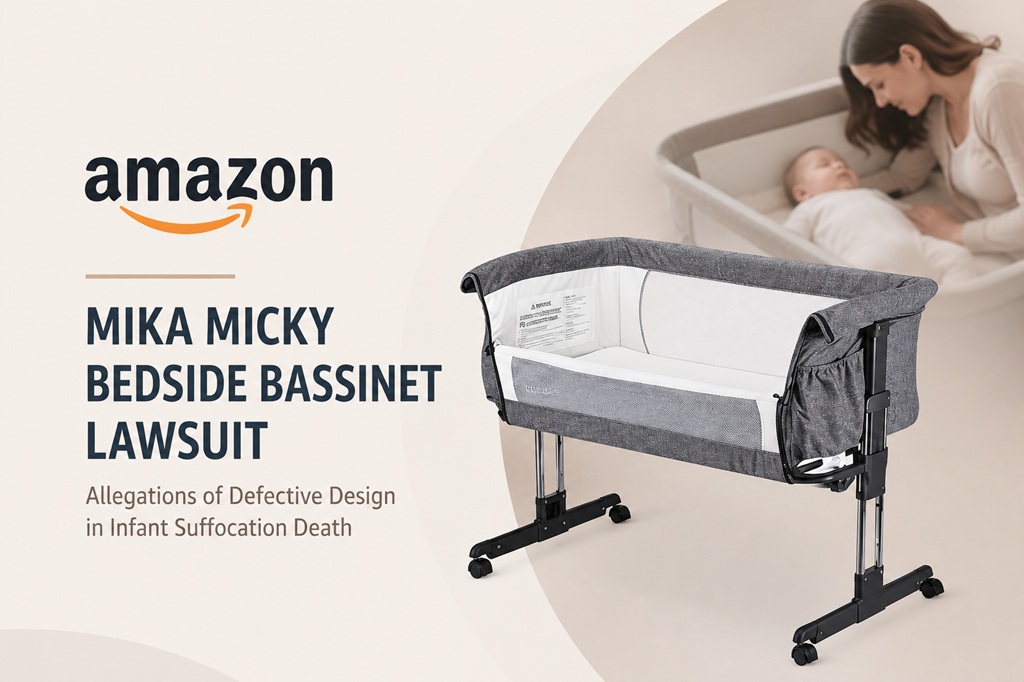
A wrongful death lawsuit filed in federal court alleges that a defective Mika Micky Bedside Bassinet contributed to the suffocation death of a five-month-old Minnesota infant. The lawsuit names both Amazon.com Inc. and Redline Commerce Inc., which does business as Mika Micky, claiming the companies sold a bedside bassinet with an unreasonably dangerous design that allegedly created a foreseeable suffocation hazard.
According to the complaint, Summer Sullivan died on February 16, 2023, after becoming trapped against the side wall of the bedside bassinet while sleeping. Her father, David Sullivan, later filed a product liability and wrongful death lawsuit alleging the bassinet’s soft, flexible side walls created “airway occlusion zones” that restricted airflow when an infant’s face pressed against the fabric. The defendants deny liability or will have the opportunity to respond through the litigation process, and the allegations have not been proven in court.
The lawsuit raises broader questions about infant sleep product safety, online marketplace liability, and whether manufacturers and retailers can be held responsible for allegedly defective products sold to consumers. It also arrives amid increased regulatory scrutiny of infant sleep products following several high-profile recalls and lawsuits involving alleged suffocation hazards.
Mika Micky Bedside Bassinet Lawsuit at a Glance
If you’re looking for a quick summary, here are the key facts about the case.
| Detail | Information |
| Case Type | Wrongful death and product liability lawsuit |
| Plaintiff | David Sullivan |
| Defendants | Amazon.com Inc.; Redline Commerce Inc. (doing business as Mika Micky) |
| Product | Mika Micky Bedside Bassinet |
| Incident Date | February 16, 2023 |
| Location | Shoreview, Minnesota |
| Victim | Summer Sullivan, age 5 months |
| Alleged Cause | Asphyxiation due to airway occlusion |
| Court | U.S. District Court for the District of Minnesota |
| Filed | January 2026 (removed to federal court on January 15, 2026) |
| Current Status | Litigation pending |
| Recall Status | No nationwide recall has been announced as of publication |
What Is the Mika Micky Bedside Bassinet Lawsuit?
The Mika Micky Bedside Bassinet lawsuit alleges that the product’s design contained a dangerous defect that allowed an infant’s face to become pressed against the bassinet’s side wall, restricting airflow and causing fatal asphyxiation. The complaint argues that this alleged hazard existed during normal and foreseeable use rather than resulting solely from misuse.
The plaintiff brings several legal claims against the manufacturer and Amazon, including strict product liability, design defect, failure to warn, negligence, and breach of warranty. Through these claims, the lawsuit alleges that a safer alternative design was available and that consumers were not adequately protected from the alleged suffocation risk.
It is important to note that filing a lawsuit does not establish liability. The allegations contained in the complaint remain claims made by the plaintiff until they are proven in court or otherwise resolved through the legal process.
Case Overview
| Detail | Information |
| Plaintiff | David Sullivan |
| Defendants | Amazon.com Inc.; Redline Commerce Inc. (d/b/a Mika Micky) |
| Product | Mika Micky Bedside Bassinet |
| Incident date | February 16, 2023 |
| Location | Shoreview, Minnesota |
| Victim | Summer Sullivan, age 5 months |
| Cause of death | Asphyxiation due to airway occlusion |
| Court | U.S. District Court, District of Minnesota |
| Filed | January 2026 (removed to federal court January 15, 2026) |
Has the Mika Micky Bedside Bassinet Been Recalled?
As of this publication, no nationwide recall of the Mika Micky Bedside Bassinet has been announced based on the allegations in this lawsuit. A lawsuit and a product recall are separate legal and regulatory processes.
A product liability lawsuit is filed by private individuals seeking compensation for alleged injuries or losses. By contrast, a product recall is generally initiated voluntarily by a manufacturer or through regulatory action after safety concerns are identified. The existence of a lawsuit does not automatically mean a recall will occur.
Parents who own a Mika Micky bedside bassinet should continue to monitor official safety announcements and follow current infant safe sleep recommendations issued by pediatric and consumer safety authorities. Parents can search the CPSC recalls database to determine whether an infant sleep product has been recalled.
What Happened
According to the complaint, Summer Sullivan was placed in a Mika Micky bedside bassinet for a nap. When her father checked on her, he found her unresponsive with her face pressed against the side wall of the bassinet. Despite emergency efforts, the infant could not be revived, and her death was attributed to asphyxiation caused by airway occlusion.
Timeline of the Mika Micky Bassinet Lawsuit
| Date | Event |
|---|---|
| February 16, 2023 | Five-month-old Summer Sullivan was found unresponsive while sleeping in a Mika Micky bedside bassinet. |
| February 2023 | The infant’s death was reported as resulting from asphyxiation due to airway occlusion. |
| January 2026 | Plaintiff filed a wrongful death lawsuit alleging a defective product design. |
| January 15, 2026 | The case was removed to the U.S. District Court for the District of Minnesota. |
| Current | Litigation remains pending, and no court has determined liability. |
The Core Allegation: A Design Flaw, Not Misuse
What separates this lawsuit from a simple product-misuse claim is the theory of the defect itself. The complaint alleges the bassinet’s side walls were not constructed with enough rigidity, creating what the filing describes as “occlusion zones” — soft, pliable areas along the interior perimeter where an infant’s face can press in and restrict airflow.
Critically, the lawsuit does not claim the product failed only when used incorrectly. It alleges the hazard exists even during normal, foreseeable use — which is the legal threshold for a design defect claim, as opposed to a failure-to-warn or misuse argument.
The complaint raises several legal theories:
- Strict product liability— the bassinet was unreasonably dangerous as designed
- Design defect— a safer, feasible alternative design existed
- Failure to warn— inadequate warnings about suffocation risk
- Negligence— the manufacturer and seller failed to exercise reasonable care
- Breach of warranty— the product didn’t perform as safely as represented
What Is Airway Occlusion?
Airway occlusion occurs when a person’s nose or mouth becomes blocked, preventing adequate airflow into the lungs. Infants are particularly vulnerable because they have limited head and neck control and may be unable to reposition themselves if their breathing becomes obstructed.
According to the complaint, the Mika Micky bedside bassinet’s side walls were allegedly soft enough to create areas where an infant’s face could become pressed against the fabric, restricting airflow. The lawsuit contends this design created a foreseeable suffocation hazard during normal use. These allegations have not yet been proven in court. Parents can also review the Safe to Sleep campaign for evidence-based guidance on reducing sleep-related infant deaths.
Understanding the Product Liability Claims
The lawsuit includes several product liability claims that are commonly raised in cases involving allegedly defective consumer products.
Design defect: The plaintiff alleges the bassinet’s overall design was unreasonably dangerous and that a safer alternative design was available.
Strict product liability: This claim argues that the product was defective regardless of whether the manufacturer exercised reasonable care during production.
Failure to warn: The complaint alleges users were not adequately warned about the alleged risk of suffocation associated with the product’s design.
Negligence: The plaintiff claims the defendants failed to exercise reasonable care in designing, manufacturing, marketing, or selling the product.
Breach of warranty: The lawsuit also alleges the bassinet failed to perform as safely as consumers would reasonably expect based on its marketing and representations.
Product liability lawsuits can involve a wide range of consumer products, including infant sleep products, cosmetics, personal care items, and household goods. Similar legal claims have also been raised in cases involving Talcum Powder Lawsuits and Honeypot Tampons Lawsuits, although each case involves different allegations, evidence, and legal issues.
Why Amazon Is Named as a Defendant
In addition to the manufacturer, the lawsuit names Amazon.com Inc. as a defendant. The complaint argues Amazon was more than a passive online marketplace and had responsibilities as a seller involved in distributing the product.
Product liability claims against online marketplaces have become increasingly common in recent years. In some jurisdictions, courts have examined whether large e-commerce platforms can be treated as sellers when they store, distribute, or facilitate the sale of products through their fulfillment networks. Whether Amazon can be held legally responsible depends on the specific facts of the case and the applicable law.
The plaintiff alleges Amazon shared responsibility for placing an allegedly defective product into the stream of commerce. Amazon has the opportunity to respond to those allegations during the litigation.
Current Status of the Lawsuit
As of July 2026, the lawsuit is pending in the U.S. District Court for the District of Minnesota. The court has not issued a final ruling on liability, and the allegations contained in the complaint have not been proven.
During the litigation, the parties may exchange evidence through discovery, present expert testimony, and file legal motions before the case proceeds to trial or reaches another resolution. Additional court filings may further clarify the parties’ positions as the case develops.
Damages Sought
The lawsuit seeks damages in excess of $50,000 — the jurisdictional threshold for wrongful death claims under Minnesota law — plus costs, interest, and any additional relief the court deems appropriate.
How This Case Fits a Larger Pattern
The Mika Micky lawsuit doesn’t exist in isolation. It arrives against the backdrop of a decade of escalating scrutiny over infant sleep products:
- 2019:The Fisher-Price Rock ‘n Play inclined sleeper was recalled after being linked to dozens of infant deaths, becoming one of the highest-profile infant product recalls in U.S. history.
- 2024:A $19 million class settlement was reached in litigation stemming from the Rock ‘n Play recall.
- 2024:Snuga Swing infant products were also recalled over safety concerns.
- October 2024:The Consumer Product Safety Commission (CPSC) finalized new federal safety rules specifically targeting infant sleep products, including cushions and pillow-like inclines, in an effort to close regulatory gaps that earlier recalls exposed.
Seen against that timeline, the Mika Micky case fits a recognizable pattern: a bedside/co-sleeper style product, a design feature (soft or unstable side walls) that seems minor until it isn’t, and a fatality that triggers litigation years after the product entered the market.
Why This Lawsuit Matters
The Mika Micky bedside bassinet lawsuit reflects broader questions about infant sleep safety, product design, and the responsibilities of online retailers.
Over the past decade, regulators, pediatric organizations, and courts have closely examined infant sleep products following recalls and litigation involving other products linked to alleged suffocation hazards. The outcome of this case may contribute to ongoing discussions about product safety standards, retailer responsibility, and how bedside bassinets are designed and marketed.
Although each product and lawsuit involves different facts, the case highlights the importance of rigorous safety testing and clear warnings for products intended for infant sleep.
What Parents Should Know
The allegations in this lawsuit have not been proven, and no court has determined that the Mika Micky bedside bassinet is defective. However, parents and caregivers may wish to stay informed as the litigation continues.
If your child was injured while using a bedside bassinet, preserving evidence may be important. This can include:
- The bassinet and all of its original components.
- Purchase receipts or online order confirmations.
- Product packaging, manuals, and warning labels.
- Photographs or videos of the product.
- Medical records related to the incident.
Parents should also continue to follow the American Academy of Pediatrics’ safe sleep recommendations, including placing infants on a firm, flat sleep surface free of loose bedding, pillows, or other soft objects.
FAQs
What bassinet was recalled?
As of publication, the Mika Micky Bedside Bassinet has not been recalled in connection with this lawsuit. However, other infant sleep products, including the Fisher-Price Rock ‘n Play Sleeper, have been recalled due to safety concerns.
How long can a newborn baby sleep in the Mika Micky bassinet?
A newborn can use the Mika Micky Bedside Bassinet only until reaching the manufacturer’s recommended weight or developmental limits, such as rolling over or pushing up on their hands. Parents should always follow the product instructions and safe sleep guidelines.
Are bedside sleeper bassinets safe?
Bedside sleeper bassinets can be safe when they meet safety standards and are used according to the manufacturer’s instructions. Infants should always sleep on a firm, flat mattress without pillows, blankets, or other soft bedding.
What is the lawsuit against Fisher-Price Rock ‘n Play?
The Fisher-Price Rock ‘n Play lawsuits alleged that the inclined sleeper’s design created a suffocation hazard linked to multiple infant deaths. The product was recalled in 2019, and numerous product liability and wrongful death lawsuits followed.
Is the Mika Micky bedside bassinet lawsuit a class action?
No. Based on publicly available information, the case is an individual wrongful death lawsuit rather than a class action.
Has the Mika Micky bedside bassinet been recalled?
As of this publication, no nationwide recall related to this lawsuit has been announced.
Why is Amazon being sued?
The complaint alleges Amazon shared responsibility for selling and distributing an allegedly defective product. Those allegations remain unproven.
Can families file a lawsuit?
Families who believe a defective product contributed to an injury or death should consult a qualified attorney to discuss their individual legal rights. Every case depends on its own facts and applicable law.
Has the court ruled on the allegations?
No. The litigation is ongoing, and the court has not determined whether the defendants are liable.
Legal Options
Families who believe a defective bassinet contributed to an infant’s injury or death may be entitled to pursue a product liability or wrongful death claim. These cases typically hinge on expert analysis of the product’s design, internal manufacturer records, and CPSC complaint history — evidence that isn’t always accessible without legal representation.
Key Takeaways
- The lawsuit alleges a design defect in the Mika Micky bedside bassinet contributed to an infant’s suffocation death.
- Amazon.com Inc. and Redline Commerce Inc. are both named as defendants.
- The complaint raises claims including design defect, strict liability, negligence, failure to warn, and breach of warranty.
- As of publication, the allegations remain unproven, and the litigation is ongoing.
- No nationwide recall related to this lawsuit has been announced.
- Families concerned about a similar incident should preserve relevant evidence and seek legal advice regarding their individual circumstances.
This article is for informational purposes only and does not constitute legal advice. If you or a loved one has been affected by a similar incident, consult a qualified attorney to discuss your legal options.

Sadia Parveen is a content writer at ClassAction24.com who creates informational articles on class action lawsuits, consumer protection matters, and legal developments. Her work focuses on researching publicly available information and presenting it in a clear and neutral format for general readers. She does not provide legal advice or professional legal services.