Kerri Thomas TSA Lawsuit 2026: Woman Alleges Airport Security Scanner Damaged Her Spinal Cord Implant
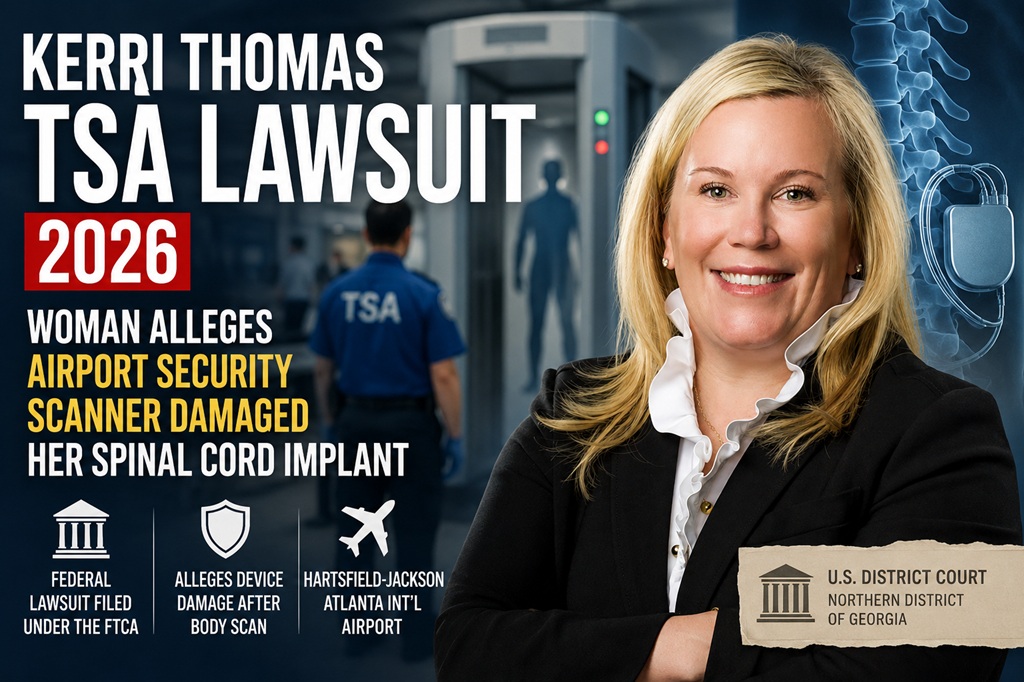
Quick answer: Kerri Thomas, a Georgia resident, filed a federal negligence lawsuit against the United States alleging that TSA officers forced her through an airport body scanner despite knowing she had an implanted spinal cord stimulator, causing an electrical shock that permanently damaged the device.
A federal lawsuit against the United States is drawing attention to how airport security handles travelers with implanted medical devices. Kerri Thomas alleges TSA officers required her to pass through a body scanner despite her repeatedly telling them she had an implanted spinal cord stimulator and requesting an alternative screening method. According to the complaint, the incident occurred on May 21, 2024, at Hartsfield-Jackson Atlanta International Airport, and the screening allegedly caused an electrical shock that permanently damaged her device, leading to surgery, ongoing pain, and other losses.
The lawsuit, filed February 18, 2026, seeks compensation under the Federal Tort Claims Act (FTCA) and names the federal government — not individual officers — as the defendant, since the officers were allegedly acting within the scope of their duties. At this stage, these remain unproven allegations; the United States has not been found liable, and the court has not determined whether TSA personnel acted negligently.
Case Number: [Insert docket number, e.g., “Case No. 1:26-cv-XXXXX, N.D. Ga.” — pull from PACER/court filing if accessible]
Quick Facts
| Item | Details |
| Plaintiff | Kerri Thomas |
| Defendant | United States of America |
| Court | U.S. District Court for the Northern District of Georgia |
| Incident Date | May 21, 2024 |
| Lawsuit Filed | February 18, 2026 |
| Legal Basis | Federal Tort Claims Act |
| Current Status | Pending |
The Airport Screening That Led to the Lawsuit
The complaint describes what Thomas says began as a routine airport security screening before her scheduled flight from Atlanta. According to the lawsuit, Thomas arrived at the airport shortly before 5:00 a.m. and proceeded to the TSA security checkpoint. Before entering the screening area, she informed a TSA officer that she had a surgically implanted spinal cord stimulator, a medical device used to manage chronic pain through electrical stimulation.
Thomas alleges that she also attempted to show the officer a medical identification card identifying the implanted device. She claims the card was ignored and that the conversation quickly shifted toward directing her through the airport screening process.
Concerned that the body scanner could interfere with her implant, Thomas says she repeatedly asked for a private pat-down instead of entering the Advanced Imaging Technology (AIT) scanner — the millimeter-wave full-body scanner used at most major U.S. airport checkpoints. According to the complaint, she explained more than once that she was uncomfortable proceeding through the scanner because of her medical device.
The lawsuit alleges that her requests were denied. According to the complaint, one TSA employee allegedly told Thomas that she could board her flight only if she passed through the body scanner. The complaint also alleges that another officer assured her the screening equipment had been adjusted or recalibrated and would not interfere with her implanted spinal cord stimulator.
Believing she had no practical alternative if she wanted to continue her trip, Thomas alleges she entered the scanner. The complaint states that almost immediately after the screening began, she experienced what she describes as an electrical shock followed by severe pain. Thomas alleges the sensation was unlike anything she had previously experienced with her spinal cord stimulator. She claims the device malfunctioned after the screening and that subsequent medical evaluations revealed damage requiring additional treatment and surgery. Those allegations form the foundation of the negligence claims now before the federal court.
Why This Lawsuit Is Different
Cases involving alleged damage to implanted medical devices during TSA screening are relatively rare. The Thomas lawsuit does not argue that airport screening itself is unlawful — it focuses on whether TSA personnel acted reasonably after being told a passenger had an implanted medical device and requested an alternative screening method. That distinction is likely to become a central legal issue.
Thomas contends TSA employees ignored information about her condition, denied a requested accommodation, and directed her through screening equipment despite knowing about the implanted device, and that she relied on assurances that the scanner would not affect it before agreeing to proceed. Whether those events occurred as described, and whether the scanner actually caused the alleged damage, remain unresolved factual questions that the case will need to address through evidence and expert testimony.
A Timeline That Became a Federal Lawsuit
According to the complaint, Thomas arrived at Hartsfield-Jackson Atlanta International Airport’s North Security checkpoint around 5:00 a.m. on May 21, 2024. She alleges that she told a TSA employee about her spinal cord stimulator and tried to show her medical ID card. The employee allegedly ignored the card. Thomas also claims TSA officers denied her repeated requests for a private pat-down instead of the AIT scanner. One officer allegedly told her she had to use the scanner to board her flight, while another allegedly assured her that the equipment had been adjusted and would not affect her device.
Thomas alleges she felt an immediate electrical shock and severe pain after entering the scanner, permanently damaging her stimulator and requiring surgery. She submitted a written administrative claim to the TSA on May 2, 2025, as required under the FTCA, and after the six-month statutory period passed without resolution, filed suit in the U.S. District Court for the Northern District of Georgia on February 18, 2026.
The Four Core Negligence Allegations
The complaint contains numerous factual allegations, but they largely revolve around four central claims that Thomas will ultimately have to prove.
1. TSA Employees Allegedly Ignored Her Medical Identification
According to the complaint, she informed a TSA employee that she had an implanted spinal cord stimulator and attempted to display her medical identification card. The lawsuit alleges the officer ignored the card and continued directing her through the standard screening process without considering the information she provided.
This allegation matters because it establishes the plaintiff’s position that TSA personnel were aware, or should have been aware, that she had an implanted electronic medical device before any screening decision was made. Whether that interaction occurred exactly as described will likely depend on witness testimony, surveillance footage, and any contemporaneous reports created after the incident.
2. Repeated Requests for a Pat-Down Were Allegedly Refused
The complaint alleges that Thomas repeatedly requested a private pat-down instead of entering the body scanner, and that those requests were denied despite her explaining why. TSA’s publicly available guidance generally states that passengers who do not wish to undergo technology-based screening may request a pat-down instead, and may ask for the screening to be conducted privately by an officer of the same sex.
Whether that general guidance applied under the specific circumstances of Thomas’s screening, and whether TSA personnel complied with applicable procedures, are issues the court will likely examine as the case progresses.
3. The Alleged Assurance About the Scanner
According to the lawsuit, a TSA employee told Thomas the scanner had been adjusted or recalibrated so it would not affect her device, and she claims she relied on that representation when deciding to proceed.
If evidence later confirms that such a statement was made, it could become relevant to questions of reasonable reliance and whether TSA personnel exercised appropriate care under the circumstances. The government may dispute that the statement was ever made or argue it has been taken out of context.
4. The Scanner Allegedly Caused the Device Failure
Thomas alleges that the body scanner immediately caused an electrical shock that damaged her spinal cord stimulator, ultimately requiring surgery. Proving that allegation will likely require expert testimony from physicians, biomedical engineers, and specialists familiar with implanted neurostimulation devices.
The plaintiff will need to demonstrate not only that the device failed, but also that the airport screening was the legal and medical cause of that failure rather than another unrelated factor. For that reason, the medical evidence may ultimately become the most closely examined aspect of the entire lawsuit.
Why TSA Policy Could Become a Central Issue
The complaint does more than allege that Thomas was injured. It also argues that the injury resulted from TSA employees failing to follow established screening procedures.
Negligence cases generally require more than proof that an injury occurred. Plaintiffs must also establish that the defendant breached a duty of care and that the alleged breach directly caused the injury. In this case, Thomas argues that the duty of care arose once TSA personnel were informed that she had an implanted medical device and requested an alternative screening method.
Whether TSA employees complied with agency procedures, whether those procedures were mandatory or discretionary, and whether any alleged deviation contributed to the claimed injuries are likely to become key questions during discovery — explored through witness testimony, internal TSA training materials, checkpoint surveillance footage, incident reports, and expert opinions on airport security procedures. At this stage, the court has not determined whether any TSA policy was violated.
Why the Federal Tort Claims Act Matters
Although the lawsuit centers on an airport security screening, it is legally a negligence action against the federal government. The complaint was filed under the Federal Tort Claims Act (FTCA), which allows individuals to seek monetary damages when they believe they have been injured by the negligent acts or omissions of federal employees acting within the scope of their employment. Because TSA officers are federal employees, Thomas sued the United States of America rather than naming individual officers as defendants.
Filing under the FTCA does not lower the plaintiff’s burden of proof. Thomas must still establish each element of a negligence claim, including that TSA employees owed her a duty of care, breached that duty, and that the alleged breach directly caused the injuries she claims to have suffered.
The Challenge of Proving Medical Causation
One of the most closely contested issues in the lawsuit is likely to be medical causation. Thomas alleges that entering the Advanced Imaging Technology scanner caused an electrical shock that permanently damaged her spinal cord stimulator, requiring surgery. Establishing a temporal connection, however, is only one part of a negligence case — Thomas will need to show that the scanner more likely than not caused the alleged device failure, which will likely require expert testimony from physicians, biomedical engineers, and pain-management specialists.
Experts may be asked to evaluate:
- Whether the stimulator was functioning normally before the airport screening
- Whether the alleged malfunction occurred immediately afterward
- Whether another medical or mechanical explanation could account for the device failure
- Whether the type of scanner involved is capable of causing the damage alleged
Medical records, diagnostic testing, surgical reports, and manufacturer information could all become important evidence during discovery.
The Evidence That May Shape the Case
Surveillance Footage. Most TSA checkpoints are monitored by security cameras. If preserved, footage may help establish the sequence of events — though it may not capture every verbal exchange.
Witness Testimony. TSA officers, other airport employees, and any observing passengers could provide relevant testimony, along with Thomas’s own detailed account of her conversations with TSA personnel.
Medical Records. These could help establish the condition of the device before the screening, the nature of the alleged malfunction, treatment timing, and whether surgery was performed because of the incident. The government may also review prior treatment records for pre-existing issues.
Expert Opinions. Specialists in pain management, neurology, biomedical engineering, medical device design, and airport screening technology may testify on whether the alleged device failure is scientifically consistent with the plaintiff’s account.
Damages Sought in the Complaint
According to the filing, Thomas seeks damages for:
- Past and future medical expenses
- Surgical treatment
- Physical pain and suffering
- Emotional distress and mental anguish
- Lost earnings and diminished earning capacity
- Permanent injuries
- Loss of enjoyment of life
- Other damages recoverable under applicable law
The complaint does not specify a total dollar amount; it asks the court to award damages determined through litigation.
What Defenses Could Be Raised?
No court has ruled on the merits of the lawsuit, and the public record does not establish the government’s litigation strategy. Negligence cases brought under the FTCA commonly involve disputes over whether personnel acted negligently, whether screening procedures were followed, and whether the alleged injuries were actually caused by the screening rather than another factor.
The government may also challenge the extent of the claimed damages or the medical evidence linking the scanner to the alleged malfunction. These are common issues in negligence litigation generally — not findings in this case.
What This Lawsuit Could Mean for Travelers With Medical Implants
Millions of Americans rely on implanted medical devices such as spinal cord stimulators, pacemakers, deep brain stimulators, insulin pumps, cochlear implants, and neurostimulators. Many pass through airport security without incident, but the lawsuit underscores the importance of clear communication between travelers and screening personnel.
The Thomas lawsuit does not claim that body scanners routinely damage implanted medical devices. It focuses on whether TSA personnel responded appropriately after being informed of an implanted device and a request for alternative screening.
If Thomas proves her claims, the case could prompt renewed attention to officer training and passenger communication. If the government successfully disputes the allegations, the lawsuit may instead reinforce the current legal framework.
Practical Tips for Travelers With Implanted Medical Devices
These recommendations are general travel guidance and should not replace advice from a healthcare provider or device manufacturer.
- Carry your medical device identification card whenever you travel
- Inform a TSA officer about your implanted device before screening begins
- Follow travel recommendations provided by your physician or device manufacturer
- Request an alternative screening method if you have concerns, where TSA procedures allow it
- Allow additional time at the airport in case further screening is required
- Keep records of any unusual incidents during screening
Current Status of the Lawsuit
As of July 2026, the lawsuit remains pending in the U.S. District Court for the Northern District of Georgia. The court has not yet determined whether TSA employees acted negligently, and neither party has publicly announced a settlement.
The litigation will likely proceed through discovery, depositions, expert witness disclosures, and pretrial motions; the parties may also pursue settlement discussions or, if they don’t resolve the case beforehand, go to trial. Readers should remember that the complaint reflects only the plaintiff’s allegations — Thomas has not yet proven them.
FAQs
What is the Kerri Thomas TSA lawsuit about?
The lawsuit alleges that TSA personnel required Kerri Thomas to pass through an airport body scanner despite knowing she had an implanted spinal cord stimulator and despite her repeated requests for a private pat-down. She claims the screening damaged her implanted medical device and caused significant physical and financial harm.
When did the alleged incident occur?
According to the complaint, the incident occurred on May 21, 2024, at Hartsfield-Jackson Atlanta International Airport.
When was the lawsuit filed?
Thomas completed the administrative claim process required under the Federal Tort Claims Act, then filed the federal complaint on February 18, 2026.
Why is the United States the defendant instead of individual TSA officers?
Because TSA officers are federal employees, plaintiffs generally bring negligence claims arising from their official duties against the United States under the Federal Tort Claims Act rather than against individual officers.
Can you sue an individual TSA agent directly?
Generally, no. If TSA employees allegedly act negligently while performing their official duties, individuals typically file claims against the United States under the Federal Tort Claims Act (FTCA) rather than suing the officers personally.
What injuries does Thomas claim she suffered?
According to the complaint, Thomas alleges the airport screening permanently damaged her spinal cord stimulator, requiring additional surgery and causing pain, medical expenses, emotional distress, lost income, and other damages.
Has the court ruled in Thomas’s favor?
No. As of the latest publicly available information, the court has not ruled on the merits of the lawsuit.
Has there been a settlement?
No public settlement has been announced.
Does this lawsuit prove that TSA body scanners damage medical devices?
No. The lawsuit contains allegations made by the plaintiff. Whether the scanner caused the alleged device damage is one of the central factual issues the court will decide based on the evidence presented during litigation.
Can passengers with implanted medical devices request an alternative TSA screening method?
TSA provides screening procedures for passengers with medical conditions and implanted devices. Depending on the circumstances, passengers may request alternative screening, including a pat-down. The application of those procedures depends on the specific situation at the checkpoint.
What happens next in the case?
The case will continue through the federal court process. Future developments may include additional court filings, expert testimony, discovery, settlement negotiations, or trial.
Conclusion
The Kerri Thomas TSA lawsuit brings together issues involving airport security, medical technology, and federal negligence law. The case does not question whether TSA should conduct airport screenings. Instead, it asks whether TSA personnel exercised reasonable care after Thomas informed them that she had an implanted medical device and requested an alternative screening method.
Thomas alleges that TSA personnel ignored her requests and that the screening permanently damaged her spinal cord stimulator. The United States has not been found liable, and the court has not determined whether TSA personnel acted negligently. As the litigation moves forward, medical experts, witness testimony, and documentary evidence will help the court determine whether Thomas can establish negligence under the Federal Tort Claims Act.

Sadia Parveen is a content writer at ClassAction24.com who creates informational articles on class action lawsuits, consumer protection matters, and legal developments. Her work focuses on researching publicly available information and presenting it in a clear and neutral format for general readers. She does not provide legal advice or professional legal services.