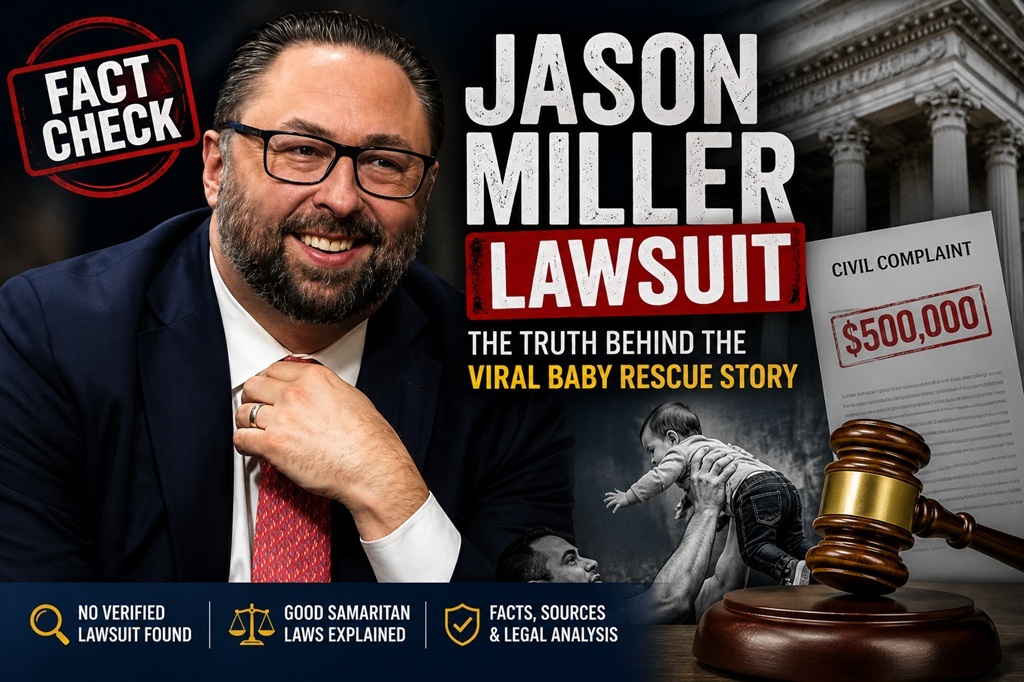
Jason Miller Lawsuit: Is the Viral Falling Baby Lawsuit Real? Full Fact Check (2026)
The Jason Miller lawsuit has become one of the most searched legal topics after a viral social media story claimed that a man named Jason Miller rescued a baby falling from a fifth-floor apartment and was later sued by the child’s mother for $500,000. The story quickly spread across Facebook, X (formerly Twitter), TikTok, Instagram, and YouTube, leading many users to believe it described a real civil lawsuit.
However, the available evidence tells a different story. Independent fact-checks have found no verified court filing, lawsuit, complaint, or official legal record supporting the claim. Multiple investigations concluded that the story was fabricated, while some of the accompanying images and videos appear to have been generated or manipulated using artificial intelligence.
Although the viral narrative is fictional, it raises genuine legal questions. Many readers want to know whether someone who saves another person’s life could actually face a lawsuit, how Good Samaritan laws work, and what legal protections emergency rescuers receive in the United States.
This guide separates verified facts from online misinformation. It also explains the legal principles behind emergency rescue cases and why publishers should carefully verify viral legal claims before presenting them as factual news
Jason Miller Lawsuit Overview
| Claim Element | Verified Status |
| Lawsuit filed | ❌ Not verified |
| Court/jurisdiction | None identified |
| Case number | None identified |
| Plaintiff identity | Unknown/unconfirmed |
| $500,000 damages figure | Originates from social media posts only |
| Rescue video authenticity | Courtroom frame confirmed to be from an unrelated case |
| Origin | Viral TikTok/Facebook posts, since October 2025 |
What Fact-Checkers Actually Found
Lead Stories / Yahoo News ran a reverse image search on the “courtroom” frame used in the viral video and found it was lifted from coverage of an unrelated case: a Denver cardiologist convicted of assaulting women he met on dating apps. A search of CourtListener, a public court-records database, returned no case matching “Jason Miller” and “reckless rescue.” The only non-social-media source repeating the claim was a two-month-old website with no disclosed ownership.
Boatos.org independently reached the same conclusion: no court filing, journalistic record, or legal database entry supports the story, and the rescue images circulating online show signs of AI generation. Neither investigation found a real lawsuit. Both found a fabricated one.
Key Takeaways
- No verified court filing confirms the alleged Jason Miller lawsuit.
- Available evidence indicates the story originated through viral social media posts.
- Independent investigations found no official legal records supporting the claim.
- Some accompanying images appear to be AI-generated or digitally manipulated.
- Readers should distinguish between viral internet stories and verified court proceedings.
The Indiana Case Is Unrelated
Some search results surface a real 2010 Indiana Court of Appeals decision, Jason D. Miller v. State of Indiana. This is a criminal sentencing appeal with no connection to a falling baby, a rescue, or a civil negligence claim. The only thing it shares with the viral story is the defendant’s name — a common false-match problem when researching people online. Matching a name alone is never sufficient; confirming a case requires matching the court, case number, filing date, and the actual parties involved.
Could Someone Really Be Sued for Saving a Child?
Setting the hoax aside, the underlying legal question is genuine: can a rescuer be held liable if their rescue causes injury? Anyone can file a lawsuit. Whether it succeeds is a separate matter, governed largely by state Good Samaritan laws, which protect people who voluntarily help in good faith during an emergency.
General conditions for Good Samaritan protection:
| Requirement | What It Means |
| Emergency exists | Immediate danger of serious injury or death |
| Good faith | The rescuer genuinely intends to help |
| Voluntary action | No pre-existing legal duty to act |
| No gross negligence | Conduct wasn’t reckless beyond what the emergency required |
These laws vary by state. California’s Health and Safety Code, for example, extends Good Samaritan immunity broadly to non-medical emergency care, while some states limit protection to licensed responders or specific settings. The protection generally covers ordinary mistakes made under pressure, not gross negligence or reckless conduct.
How a Real Negligence Claim Would Be Evaluated
If an actual rescue-injury lawsuit existed, courts would apply the standard four-part negligence test:
- Duty of care— Did the rescuer owe the child a legal obligation?
- Breach— Did their conduct fall below what a reasonable person would do in an emergency?
- Causation— Did that conduct directly cause the injury?
- Damages— Did the child suffer measurable harm?
All four must hold up under evidence; failing even one defeats the claim. Courts judge emergency conduct against what a reasonable person would do in the moment, not with the benefit of hindsight — which is precisely why Good Samaritan statutes exist: to avoid discouraging people from helping for fear of liability.
Why This Story Spread So Easily
The narrative follows a familiar misinformation pattern: a heroic act, an unjust legal twist, and a call to outrage — all wrapped in AI-generated visuals realistic enough to pass as authentic footage. Once a few low-quality sites repeated the claim without verification, search engines began surfacing it as though it were independently corroborated, even though every instance traced back to the same unverified post. This is sometimes called an information cascade, and it’s a growing risk specifically for AI-generated legal and medical misinformation, both YMYL categories where Google holds publishers to a higher accuracy standard.
This isn’t an isolated pattern. A similar viral-claim cycle played out with the Caroline Leavitt lawsuit against The View, where social media circulated a defamation claim that didn’t match the actual legal record.
Why Court Records Matter More Than Viral Posts
One of the biggest lessons from the Jason Miller story is the importance of verifying legal claims through reliable sources. Social media posts often present dramatic allegations without supporting documentation.
Official court records provide a much stronger foundation because they typically include:
- Filed complaints
- Motions
- Judicial orders
- Hearing schedules
- Attorney appearances
- Case numbers
- Court rulings
When these records cannot be located, readers should approach viral legal claims with caution. Responsible journalism requires more than repeating popular stories. It requires verification.
The same principle applies even when a lawsuit is real: in the Trulife Distribution lawsuit, the court record showed no finding of fraud despite widespread claims to the contrary, underscoring why primary sources matter more than secondhand narratives.
Myth vs. Fact
| Myth | Fact |
| Jason Miller was sued after saving a baby | No court record confirms this |
| The lawsuit sought exactly $500,000 | The figure comes only from social posts |
| The viral video proves it happened | Footage is AI-generated / repurposed from an unrelated case |
| The Indiana Justia case confirms it | Unrelated 2010 criminal appeal, different case entirely |
| Good Samaritans can always be sued successfully | Most states provide meaningful legal protection for good-faith rescues |
FAQs
What happened to the actor Jason Miller?
Jason Miller was an American actor and Pulitzer Prize-winning playwright best known for The Exorcist. He died on May 13, 2001, after suffering a heart attack. His death is unrelated to the viral Jason Miller lawsuit story.
What happened with the lawsuits against Abby Lee Miller?
Abby Lee Miller has faced several legal disputes, including civil lawsuits related to Dance Moms and a federal bankruptcy fraud case. More recently, she filed a medical malpractice lawsuit against a hospital following spinal surgery.
Who is Jason Miller?
Jason Miller is an American political strategist and former senior adviser to President Donald Trump. He is also the founder and CEO of the social media platform GETTR. The viral “Jason Miller lawsuit” story has not been verified through official court records.
Is Stephen Miller suing the Dodgers?
No verified court records or credible news reports indicate that Stephen Miller has filed a lawsuit against the Los Angeles Dodgers as of 2026.
Is the Jason Miller lawsuit real?
No verified court filing, case number, or docket entry has been found. Independent fact-checks concluded the story is fabricated.
Was Jason Miller sued for $500,000?
That figure appears only in social media posts, not in any court record.
Did someone really catch a falling baby?
Investigators could not confirm the rescue occurred as described; the accompanying footage and images show signs of AI generation.
Can you actually be sued for rescuing someone?
Yes, anyone can file a lawsuit, but Good Samaritan laws in most states protect good-faith rescuers from liability for ordinary mistakes made during a genuine emergency.
Does the Indiana court case prove the story?
No. Jason D. Miller v. State of Indiana (2010) is an unrelated criminal appeal that happens to share a name with the viral story’s subject.
Bottom Line
The Jason Miller falling-baby lawsuit is a viral hoax, not a documented legal case. No court record, case number, or credible news report supports it, and two independent fact-checking investigations identified AI-generated imagery and a misattributed courtroom clip as its source. The underlying legal question it raises, whether rescuers can be sued, is real and worth understanding, but this particular story isn’t.
This article will be updated if new verified information becomes available. Sources: Lead Stories/Yahoo News, Boatos.org, CourtListener, Justia.

Sadia Parveen is a content writer at ClassAction24.com who creates informational articles on class action lawsuits, consumer protection matters, and legal developments. Her work focuses on researching publicly available information and presenting it in a clear and neutral format for general readers. She does not provide legal advice or professional legal services.