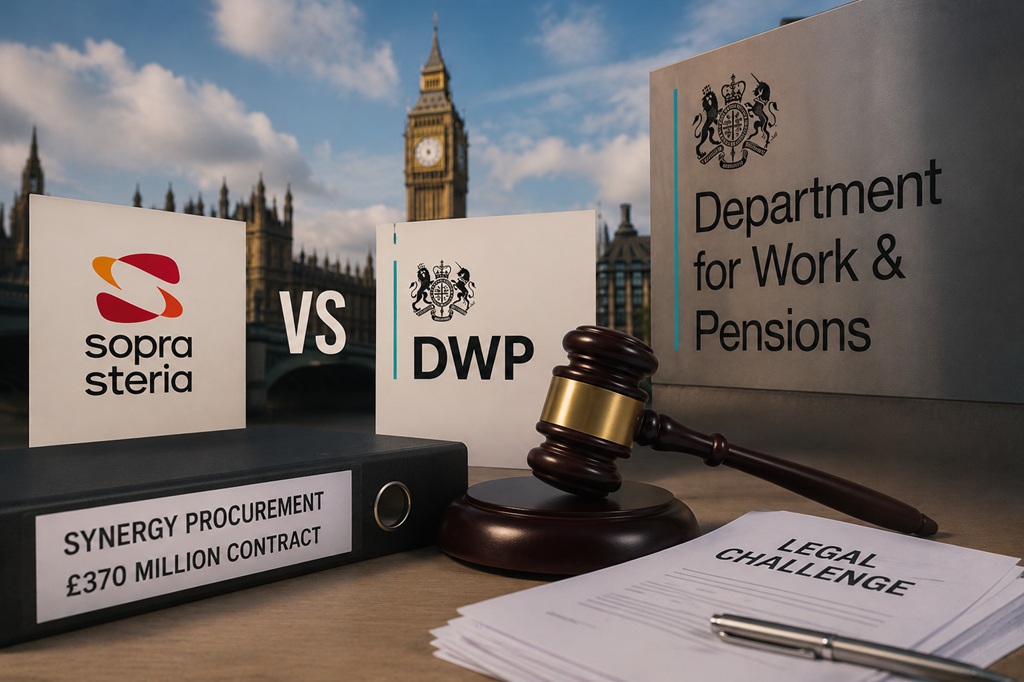
Sopra Steria vs DWP Lawsuit 2026: The £370M Synergy Procurement Challenge Explained
Sopra Steria filed a legal challenge in January 2026 against the UK Department for Work and Pensions (DWP) after losing the Synergy Business Process Services (BPS) contract to Capita. The contract was estimated at up to £958.7 million over ten years, but Capita’s winning bid came in at approximately £370 million — roughly 40% of the estimated value and well below the DWP’s own £642 million Should Cost Model.
Sopra Steria alleges the DWP failed to properly assess the bid as abnormally low under the Public Contracts Regulations 2015 (PCR 2015), issued a clarification request after the evaluation end date, and renegotiated material commercial terms with Capita after selecting it as preferred bidder. Sopra Steria is asking the court to terminate and/or rerun the procurement, and is also seeking damages. The DWP and Capita deny all allegations. No hearing date has been set as of June 2026.
Case Snapshot
| Item | Details |
| Case | Sopra Steria procurement challenge against DWP |
| Claimant | Sopra Steria (via its subsidiary SSCL) |
| Defendant | UK Department for Work and Pensions (DWP) |
| Successful Bidder | Capita |
| Programme | Synergy Programme — Business Process Services (BPS) |
| Estimated Contract Value | Up to £958.7 million (10 years including extensions) |
| Capita’s Actual Bid | Approximately £370 million |
| DWP Should Cost Model | £642 million |
| Legal Framework | Public Contracts Regulations 2015 (PCR 2015) |
| Services Covered | Payroll, HR, finance, recruitment, service desk — ~250,000 civil servants |
| Remedies Sought | Termination and/or rerun of procurement; damages |
| Current Status | Ongoing — no hearing date set (June 2026) |
Key Takeaways
- Capita’s winning bid of ~£370 million was approximately 42% below the DWP’s £958.7 million contract estimate and well under its own £642 million Should Cost Model.
- Sopra Steria is the incumbent provider of the very services being retendered, operating through its subsidiary SSCL since 2013.
- The DWP issued a clarification request to Capita after the evaluation end date — a procedural point central to the legal claim.
- A confidential “Comparison Document” was sent in error to SSCL staff, triggering a secondary dispute over an Ethical Wall Agreement (EWA).
- The PCS union called the award a “reckless gamble”; the Public Accounts Committee described it as “extraordinary.”
- The DWP and Capita both deny all allegations of procurement irregularity.
- IBM and Oracle separately won the related £711 million ERP and systems integration contract as part of the same Synergy programme.
What Is the Sopra Steria vs DWP Lawsuit?
The Sopra Steria vs DWP lawsuit is a public procurement challenge arising from one of the UK’s largest ongoing government transformation programmes. It is not a standard commercial dispute about service delivery — it is a legal challenge to the procurement process itself: how bids were evaluated, how an unusually low price was assessed, and what happened after a preferred supplier was selected.
What makes this case unusual is the identity of the challenger. Sopra Steria is not an outside party. Through its subsidiary SSCL (Shared Services Connected Ltd), it has operated the Oracle-based back-office shared services for DWP, the Ministry of Justice, the Cabinet Office, and Defra since 2013. It was both a bidder and the sitting provider — making the stakes, and the legal complexity, considerably higher than a typical procurement challenge.
Who Are the Parties?
Sopra Steria is a French-headquartered European IT consulting and business process services company operating across more than 30 countries, with a substantial UK public sector presence. Its subsidiary SSCL (Shared Services Connected Ltd) delivers payroll, HR, finance, and procurement operations to multiple central government departments using Oracle eBusiness Suite 12.2.6, a role it has held since 2013.
The DWP (Department for Work and Pensions) is the lead contracting authority for the Synergy programme. It is responsible for the BPS procurement and is defending all allegations in this case.
Capita is the UK outsourcing company selected as the preferred supplier for the BPS contract. It has stated it participated in a robust procurement process and stands ready to deliver the services. Capita will provide payroll, HR, recruitment, finance, procurement, and service desk support for approximately 250,000 civil servants across four government departments using the Oracle Fusion platform that IBM and Oracle are developing under a separate £711 million contract.
Oracle and IBM won the related Synergy ERP and systems integration contract for £711 million in 2024. Capita’s BPS contract is operationally dependent on the platform they are building.
What Is the Synergy Programme?
The Synergy Programme is a DWP-led cross-government initiative to consolidate HR, finance, payroll, procurement, and back-office services for four departments — DWP, the Ministry of Justice (MoJ), the Home Office, and the Department for Environment, Food and Rural Affairs (Defra) — onto a single Oracle Fusion cloud-based platform. The programme is part of the UK government’s broader Shared Services Strategy, launched in 2018, which aims to cut the cost and complexity of operating separate legacy systems across departments. The government claims the strategy will deliver £4 billion in benefits.
The Synergy cluster involves three linked contracts:
- ERP technology and systems integration — awarded to Oracle and IBM for £711 million in 2024
- Business Process Services (BPS) — the contract at the centre of this litigation, estimated at £958.7 million
- Incumbent shared services — currently operated by SSCL (Sopra Steria’s subsidiary)
The total estimated commitment across the Synergy cluster and related shared services strategy exceeds £1.7 billion. The Register estimates cumulative contracts across the entire cross-government Shared Services Strategy at approximately £2 billion.
Why Did Sopra Steria File the Lawsuit?
Sopra Steria filed its legal claim in January 2026, approximately one month after DWP confirmed in December 2025 that Capita had won the tender. The claim rests on four core allegations.
Capita’s Bid Was Abnormally Low and Inadequately Assessed
Capita’s winning bid was approximately £370 million for ten years. The DWP’s own estimated contract value was £958.7 million. More significantly, the DWP had developed a Should Cost Model (in accordance with Cabinet Office guidelines) that put the realistic contract price at £642 million.
The Cabinet Office Sourcing Playbook states that if a bid is more than 10% lower than either the average of competing bids or the Should Cost Model estimate, it must be referred to the Cabinet Office’s Government Commercial Function for review. Capita’s bid of £370 million was approximately 42% below the Should Cost Model — far exceeding that referral threshold.
Sopra Steria alleges the DWP’s assessment of Capita’s bid as “not abnormally low” was incorrect and procedurally flawed. Sopra Steria further claims that Capita’s pricing reflects staffing levels well below the current operational requirements and DWP’s own projections, raising questions about whether Capita can deliver the services as proposed.
Court filings reveal the DWP’s own internal assessment had, as of July 2025, flagged Capita’s implementation service charges as appearing abnormally low. The DWP subsequently issued clarification requests.
Clarification Was Issued After the Evaluation End Date
The DWP made two requests for clarification regarding Capita’s pricing. Sopra Steria alleges that one clarification request was issued in August 2025 — after the formal evaluation end date. Following that clarification process, the DWP determined Capita’s bid was “not abnormally low.” Sopra Steria contends this post-deadline clarification was procedurally improper under the PCR 2015.
Material Terms Were Renegotiated After Preferred Bidder Selection
Sopra Steria’s particulars of claim allege that the DWP, Oracle, and IBM discussed a change request involving the consolidation and postponement of go-live dates across the Synergy departments, along with alterations to parts of the solution. The DWP then renegotiated Capita’s tender to help it align with this change request — after Capita had already been selected as preferred bidder.
Sopra Steria argues that DWP excluded it from this process. It claims that DWP’s renegotiation materially changed the commercial terms of the competition, breached procurement rules, and denied other bidders an equal opportunity to compete on the revised terms.
The Comparison Document and Ethical Wall Agreement
An additional strand of the litigation concerns a document referred to in court filings as the “Comparison Document.” Both parties agree this document was sent in August 2025 to one SSCL employee and one SSCL contractor — staff within Sopra Steria’s subsidiary. Sopra Steria alleges the document contained summaries of both its own bid and Capita’s bid, and that it had been circulated among at least eleven DWP staff, including bid evaluators.
After Sopra Steria told the DWP it had been allowed access to the document, the DWP wrote to it saying there had been a ‘breach of confidentiality’ which was under investigation — a reminder that procurement documents held by government departments can carry significant legal weight, and understanding what public records law requires is relevant context for any supplier navigating a challenge. The DWP had signed an Ethical Wall Agreement (EWA) with Sopra Steria to prevent conflicts of interest during the procurement — and it alleges Sopra Steria breached that agreement by using the document in its legal claim.
Sopra Steria denies any breach. It disputes the DWP’s characterization of the document as internal planning material, and argues it revealed evidence of post-selection renegotiation. The DWP maintains the document was created after bid evaluation, was shared with evaluators “not for the purposes of evaluation,” and was designed only to support transition planning.
This dispute within the dispute — over the document’s provenance, its use in litigation, and who (if anyone) breached the EWA — adds a layer of procedural complexity and may affect how evidence is weighed at trial.
What the DWP and Capita Say
The DWP has denied all allegations of procurement irregularity. Its Senior Responsible Officer for the Synergy Programme, Dianne Jeans, told the Public Accounts Committee: “The award to Capita followed all the government regulations and processes. We also had strong legal and commercial oversight and subject matter experts from all four Departments assessing the competing bids throughout the whole process. Capita emerged as the clear preferred bidder under Government procurement processes.”
A DWP spokesperson said: “We are aware of the legal challenge and are cooperating fully with the relevant processes. As this matter is currently subject to litigation, it would be inappropriate to comment further at this time. Our priority is to ensure continuity of service and value for money for the public.”
Capita has stated it took part in a robust procurement process and stands ready to work with the DWP to ensure a smooth transition of service and value for money.
What Remedies Is Sopra Steria Seeking?
Sopra Steria is asking the court for two primary remedies:
Termination and/or rerun of the procurement. If the court finds the procurement was conducted in breach of PCR 2015, it could order the contract to be terminated and the competition to be re-run — allowing all qualified suppliers, including Sopra Steria, to compete again on corrected terms.
Damages. Sopra Steria is also seeking financial compensation for losses resulting from the allegedly unlawful procurement process.
No hearing date has been set as of June 2026, with the court still assessing further commercially sensitive information.
Political and Parliamentary Context
The Synergy BPS contract has drawn scrutiny beyond the courts. The Public Accounts Committee described the DWP’s decision to award the contract to Capita as “extraordinary,” with Labour MP Clive Betts questioning why DWP would select Capita given its track record on the Civil Service Pension Scheme — where the system launched without full functionality, generated a backlog of 86,000 unresolved cases, and prompted widespread complaints about login failures and broken links.
The Public and Commercial Services (PCS) Union described the award as a “reckless gamble.” PCS General Secretary Fran Heathcote said: “Capita is already at the centre of a pensions crisis that has left retired civil servants in distress.” The union claimed Capita’s winning bid was £700 million — a figure the DWP has neither confirmed nor denied publicly.
Separately, in April 2026, the government terminated Capita’s contract to administer the Royal Mail Statutory Pension Scheme — adding further political pressure around the decision to award the Synergy BPS contract to the same company.
The Legal Framework: PCR 2015
Because the Synergy BPS procurement was launched in September 2024, it falls under the Public Contracts Regulations 2015 (PCR 2015) rather than the newer Procurement Act 2023 (which applies to procurements commenced on or after February 2025).
Under PCR 2015, contracting authorities are required to:
- Treat all bidders equally and without discrimination
- Conduct evaluation transparently and in accordance with pre-published criteria
- Investigate tenders that appear abnormally low and seek explanations before accepting or rejecting them
- Avoid making material changes to a contract after award that would have altered the competitive outcome
Where these obligations are breached, unsuccessful bidders may challenge the award through the courts. The remedies available include contract termination, rerun of the process, and/or damages.
The Cabinet Office Sourcing Playbook — which applies to complex outsourcing projects — requires contracting authorities to produce a Should Cost Model and stipulates that bids more than 10% below that model or below the average of other bids must be referred to the Cabinet Office’s Government Commercial Function. This referral threshold is central to the factual dispute in this case.
What Is an Abnormally Low Tender?
Under PCR 2015, an abnormally low tender is a bid whose price appears so low that the contracting authority has reason to doubt the supplier can realistically perform the contract. The regulations do not define a precise numerical threshold, but the Cabinet Office Sourcing Playbook operationalizes this with the 10% rule.
Importantly, a low bid is not automatically rejected. The authority must request an explanation and assess whether the pricing is sustainable. Valid justifications can include innovative delivery methods, automation, economies of scale, or existing infrastructure. Only if the authority remains unsatisfied after receiving the explanation may it reject the bid.
In this case, the factual dispute turns on whether the DWP’s clarification process — including the timing of the August 2025 clarification request issued after the evaluation deadline — constituted a proper assessment, or whether it was procedurally defective in the way the PCR 2015 requires.
Timeline of the Dispute
| Date | Event |
| 2013 | Sopra Steria’s subsidiary SSCL begins running Oracle-based back-office shared services for DWP, MoJ, Cabinet Office, and Defra |
| 2018 | Cabinet Office launches 10-year Shared Services Strategy for Government |
| August 2024 | Oracle and IBM win £711 million Synergy ERP and systems integration contract |
| September 2024 | DWP launches BPS competition, estimated at £958.7 million over 10 years |
| July 2025 | DWP’s own internal assessment flags Capita’s implementation charges as appearing abnormally low |
| August 2025 | DWP issues clarification request to Capita — alleged to be after the formal evaluation end date. A “Comparison Document” comparing bids is inadvertently sent to SSCL staff |
| After August 2025 | Following clarification process, DWP determines Capita’s bid is “not abnormally low” |
| December 2025 | DWP informs Sopra Steria that Capita has won the tender |
| January 2026 | Sopra Steria files legal challenge against DWP |
| February 2026 | Legal challenge becomes publicly known via media reporting; Capita’s ~£370 million bid figure emerges |
| March 2026 | Capita contract (7 years with 3 annual extensions) scheduled to start; PCS union calls award a “reckless gamble”; PAC describes decision as “extraordinary” |
| April 2026 | DWP files defence; Comparison Document dispute and Ethical Wall Agreement allegations become public; Government terminates Capita’s Royal Mail Statutory Pension Scheme contract |
| May–June 2026 | Sopra Steria files reply to defence; Should Cost Model figure (£642 million) disclosed in court filings. No hearing date set |
Why This Case Matters Beyond One Contract
The significance of this litigation extends well beyond a single outsourcing decision. It tests the 10% Should Cost Model rule in court. No published judgment has directly addressed how the Cabinet Office Sourcing Playbook’s referral threshold interacts with the PCR 2015 abnormally low tender regime. A ruling here could establish precedent for how contracting authorities handle price outliers in all complex outsourcing procurements.
It addresses the legality of post-selection renegotiation. The allegation that the DWP renegotiated commercial terms after naming Capita as preferred bidder goes to a fundamental principle of procurement law. A judgment on when such discussions cross the line into unlawful amendment could reshape how government departments manage the preferred bidder stage.
It implicates the Ethical Wall Agreement model. The Comparison Document dispute raises questions about how government departments manage information barriers when the incumbent provider is also a competing bidder — a scenario that will recur in future recompetitions.
It affects 250,000 civil servants. The Synergy programme underpins payroll, HR, and finance operations across DWP, MoJ, Home Office, and Defra. Any delay, rerun, or uncertainty directly affects service continuity for the public servants who depend on these systems.
This occurs against a backdrop of wider shared services uncertainty. A National Audit Office report published in early 2026 noted that departmental buy-in to the government’s shared services strategy is not clear, and that HM Treasury has yet to make a firm commitment to joining the Matrix shared service cluster — adding broader strategic risk to the programme.
FAQs
Is Sopra Steria a Prestigious Company?
Yes. Sopra Steria is a well-established European IT consulting and digital transformation company. It serves governments and major enterprises across more than 30 countries and is recognized for delivering large-scale technology, cybersecurity, cloud, and business process outsourcing projects. Its long history and extensive public sector experience make it one of Europe’s respected technology service providers.
What is the Sopra Steria vs DWP lawsuit about?
It is a procurement challenge in which Sopra Steria alleges the DWP unlawfully awarded the Synergy Business Process Services contract to Capita. The core allegations concern the assessment of an abnormally low bid, a post-deadline clarification request, and post-selection renegotiation of commercial terms.
What was Capita’s actual bid value?
Approximately £370 million over ten years. The DWP estimated the contract at up to £958.7 million, and its own Should Cost Model put the realistic price at £642 million — making Capita’s bid roughly 42% below the model estimate.
What is the Should Cost Model and why does it matter?
A Should Cost Model is a cost estimate that contracting authorities must develop on complex outsourcing contracts under Cabinet Office guidelines. It serves as a benchmark for assessing value for money and identifying abnormally low bids. The Sourcing Playbook states that any bid more than 10% below the model must be referred to the Cabinet Office’s Government Commercial Function. In this case, Capita’s bid was approximately 42% below the £642 million Should Cost Model.
What is an Ethical Wall Agreement?
An Ethical Wall Agreement (EWA) is a contractual arrangement designed to prevent conflicts of interest where the same company is both a competing bidder and a current service provider. The DWP signed an EWA with Sopra Steria to ensure SSCL staff involved in current service delivery did not share competitively sensitive information with the BPS bid team. The DWP alleges Sopra Steria breached this agreement by using the inadvertently shared Comparison Document in its legal claim. Sopra Steria denies any breach.
What is the Comparison Document?
The Comparison Document is an internal DWP document that summarizes both bidders’ proposals. Sopra Steria alleges that DWP circulated the document among evaluators after SSCL staff accidentally received it. DWP, however, states that officials created the document only after they completed the evaluation for internal transition planning and that the document did not affect the procurement process.
What is SSCL?
SSCL (Shared Services Connected Ltd) is a subsidiary of Sopra Steria. It has operated the Oracle-based HR, payroll, and finance shared services for DWP, MoJ, the Cabinet Office, and Defra since 2013. The fact that the company challenging the procurement is also the incumbent provider running the service makes this case particularly unusual.
What legal framework applies?
The procurement falls under the Public Contracts Regulations 2015 (PCR 2015) because DWP launched the competition in September 2024, before the Procurement Act 2023 took effect in February 2025.
Does the legal challenge automatically cancel the contract?
No. A procurement challenge does not invalidate an awarded contract unless the court makes a specific order. The contract with Capita remains in effect during proceedings unless the court orders otherwise.
What remedies is Sopra Steria seeking?
Sopra Steria is asking the court to terminate and/or rerun the procurement process, and is also seeking financial damages.
What did the Public Accounts Committee say?
Committee chair Sir Geoffrey Clifton-Brown described the DWP’s decision as “extraordinary.” Labour MP Clive Betts questioned why the DWP would select Capita given its troubled performance on the Civil Service Pension Scheme.
What did the PCS union say?
PCS General Secretary Fran Heathcote called the award a “reckless gamble,” noting Capita was already at the centre of a pensions crisis affecting retired civil servants.
What is the current status of the case?
As of June 2026, the case is ongoing. Sopra Steria has filed its claim and its reply to DWP’s defence. No hearing date has been set, pending court assessment of commercially sensitive information.
Who won the related Synergy ERP contract?
Oracle and IBM won the Synergy ERP technology and systems integration contract for £711 million in August 2024.
Is Sopra Steria a reputable company?
Yes. Sopra Steria is a well-established European IT services and business process outsourcing company operating in more than 30 countries, with an extensive public sector track record in the UK including defence, pensions, and cross-government shared services.
Conclusion
The Sopra Steria vs DWP lawsuit is the most closely watched UK public procurement dispute of 2026. At its centre is a stark pricing gap: a contract estimated at £958.7 million, benchmarked by the DWP’s own Should Cost Model at £642 million, awarded for approximately £370 million. Whether that gap reflects legitimate commercial innovation or a failure to properly apply the abnormally low tender regime under PCR 2015 is the question the court must answer.
The case touches on multiple live issues in public procurement law: the 10% Should Cost Model threshold, the legality of post-deadline clarification, the limits of post-selection negotiation, and the management of information barriers where an incumbent provider is also a competing bidder. A judgment on any one of these could set precedent with lasting effect on how central government awards and challenges major outsourcing contracts.
Regardless of the lawsuit’s outcome, the available information shows that DWP identified concerns about Capita’s pricing before awarding the contract. DWP later addressed those concerns through a clarification process that Sopra Steria now disputes in court. The ongoing litigation will determine whether those procurement decisions complied with the applicable legal requirements. Procurement professionals, contracting authorities, and public sector suppliers should closely follow the Sopra Steria case because it may shape future public procurement practices.

Sadia Parveen is a content writer at ClassAction24.com who creates informational articles on class action lawsuits, consumer protection matters, and legal developments. Her work focuses on researching publicly available information and presenting it in a clear and neutral format for general readers. She does not provide legal advice or professional legal services.