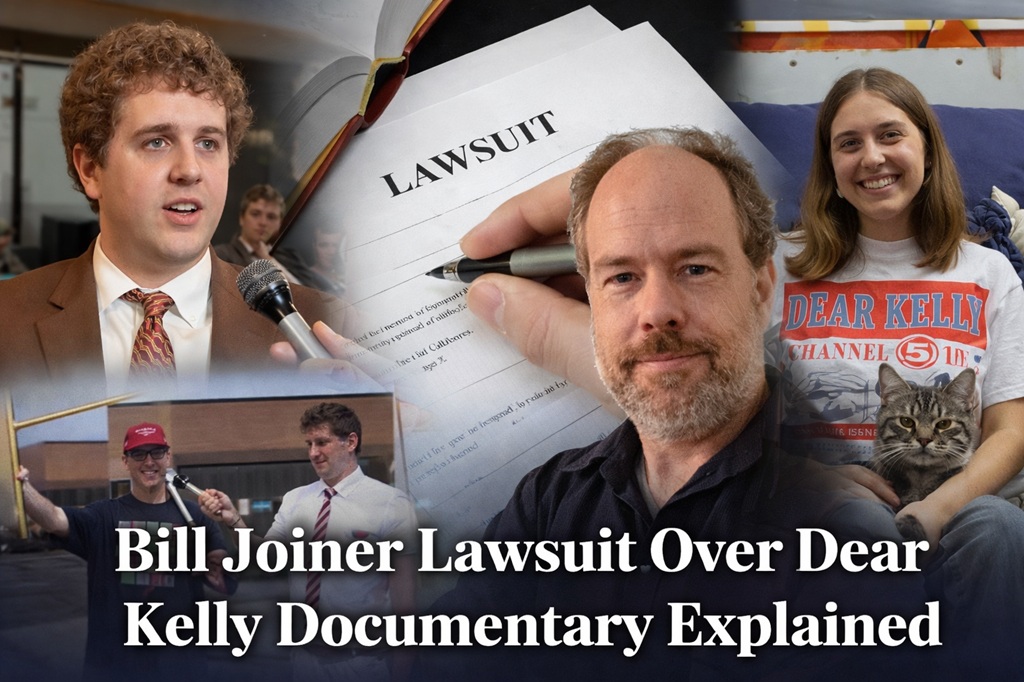
Bill Joiner Lawsuit: Federal Case, Legal Claims, and Documentary Dispute Explained
The Bill Joiner lawsuit is a federal civil case filed on May 30, 2024, in the U.S. District Court for the Central District of California. William G. Joiner brought a federal civil complaint against media figures and a production company tied to the documentary Dear Kelly. Court records identify the case as 8:24-cv-01160. The lawsuit centers on alleged reputational harm and related statutory claims arising from Joiner’s portrayal in the film. Legal observers describe the dispute as a documentary defamation lawsuit that tests the boundaries between nonfiction storytelling and constitutional free speech protections.
The complaint targets Channel 5 LLC, filmmaker Andrew Callaghan, and other individuals connected to the production. Joiner argues that the documentary presents him in a misleading and damaging light. Defendants have not been found liable, and no final ruling has been issued. This article examines the federal court filing, the legal claims involved, and the broader implications for media liability, First Amendment protections, and documentary filmmaking standards.
Case Overview: Federal Filing Details
William G. Joiner filed the lawsuit on May 30, 2024. The case proceeds under federal civil jurisdiction in the U.S. District Court for the Central District of California.
Plaintiff
- William G. Joiner
Defendants
- Channel 5 LLC
- Andrew Callaghan
- Evan Gilbert-Katz
- Nicolas Mosher
- Kelly S. Johnson
- Does 1–200
The complaint includes a jury demand. The court has not issued a final ruling. The case remains active on the federal docket. Public docket entries confirm standard civil procedure steps. Summons issuance and counsel appearances form part of the early record. No verdict exists at this stage.
What Is Dear Kelly?
Dear Kelly is a nonfiction documentary film produced by Channel 5. Andrew Callaghan directed the project. The film falls within the independent investigative documentary genre.
The documentary focuses on Kelly Johnson. The story examines financial hardship, foreclosure proceedings, and political belief shifts. The narrative structure follows Johnson’s personal account of events that shaped his life. Interviews and recorded conversations drive the storyline.
The film addresses themes such as mortgage disputes, private lending, property loss, and ideological change. Viewers see Johnson’s perspective on how financial collapse affected his worldview. The documentary presents those claims as part of a personal narrative framework.
William Joiner appears in the film in relation to a foreclosure dispute. The documentary references his role in connection with lending or property matters. Joiner is not the main subject of the project. However, the film mentions his name during discussions about the foreclosure process.
This reference forms the foundation of the Bill Joiner lawsuit. Joiner argues that the portrayal created reputational harm. The dispute centers on whether the documentary presented factual assertions or protected opinion within a storytelling context.
Documentary law often examines narrative framing, editorial discretion, and contextual accuracy. Courts assess whether a reasonable viewer would interpret statements as factual claims. Judges also consider First Amendment protection for expressive works.
Search users often look for:
- Dear Kelly, documentary controversy
- Andrew Callaghan Dear Kelly, lawsuit
- Channel 5 foreclosure documentary
- William Joiner, Dear Kelly, reference
- Bill Joiner documentary dispute
This context explains why Dear Kelly sits at the center of the Bill Joiner federal lawsuit. The film’s portrayal triggered the legal claims now under review in federal court.
Core Legal Issue: What Does the Bill Joiner Lawsuit Allege?
The Bill Joiner lawsuit centers on alleged reputational harm tied to the documentary Dear Kelly. William G. Joiner claims that the film presents him in a misleading and damaging light. The complaint asserts that viewers could draw negative conclusions about his role in a foreclosure dispute. Joiner argues that the documentary creates a false or distorted impression. Reputational injury stands at the core of the civil action.
Defamation law requires proof of a false statement of fact, publication, fault, and measurable harm. Courts assess whether a reasonable viewer would interpret the portrayal as factual and defamatory. Courts often evaluate early dismissal requests under Rule 12(b)(6), which tests whether the complaint states a plausible claim for relief.
The lawsuit also references statutory claims linked to federal communication laws. Public case summaries mention possible wire-related allegations. Federal statutes regulate unauthorized interception, disclosure, and recording of certain communications. Judges analyze consent, intent, and statutory scope when such claims arise. The complaint frames these allegations under federal civil jurisdiction. The court will review the pleadings under Rule 12 standards if motions to dismiss appear. Judges often evaluate whether the complaint states a plausible claim for relief under established precedent.
No court has determined liability in this matter. These claims reflect allegations contained in the filed complaint. The litigation process will determine whether the evidence supports those assertions.
Search users often look for:
- Bill Joiner’s defamation lawsuit details
- William Joiner Channel 5 legal claims
- Dear Kelly, Reputational harm allegations
- Federal wire interception lawsuit documentary
- Central District of California media dispute
This section explains the legal foundation of the Bill Joiner federal case. The outcome will depend on statutory interpretation, constitutional defenses, and evidentiary findings.
Understanding Reputational Harm and Defamation Law
Reputational harm usually arises under defamation law. Civil defamation claims require proof of specific legal elements commonly referred to as defamation law elements. Courts apply a structured test before allowing a case to proceed. Public figures must meet the actual malice standard, which requires proof that the defendant knew a statement was false or acted with reckless disregard for the truth.
A plaintiff must generally prove:
- A false statement of fact
- Publication to a third party
- Fault
- Actual damages
A false statement of fact forms the foundation of any defamation claim. The law does not punish opinions, satire, or rhetorical language. Courts separate factual assertions from protected commentary. Publication means that someone other than the plaintiff saw or heard the statement. Documentary films meet this requirement once they are released to the public. Wide distribution can increase the scope of alleged damages.
Fault depends on the plaintiff’s status. Private individuals must usually show negligence. Public figures must prove actual malice. Actual malice requires knowledge of falsity or reckless disregard for the truth. Courts examine evidence carefully before reaching that conclusion. Damages refer to measurable harm. Plaintiffs may allege loss of reputation, emotional distress, or economic injury. Judges require more than speculation. Evidence must support the claimed harm.
Courts also analyze context. Judges review the full narrative, editing decisions, and overall presentation. A reasonable viewer standard applies in most cases. The court asks how an average audience member would interpret the content. Truth serves as a complete defense. Accurate reporting cannot support a defamation claim. Opinion also receives constitutional protection under the First Amendment. Expressive works, including documentaries, enjoy broad legal safeguards.
The court must decide whether the film contains actionable false statements or protected speech. That legal framework shapes the Bill Joiner federal lawsuit. The outcome will depend on evidence, legal standards, and constitutional interpretation.
Communication and Wire-Related Claims Explained
Federal law regulates the unauthorized interception and disclosure of communications. Plaintiffs sometimes rely on wiretap statutes in media-related disputes. These laws protect certain private conversations from unlawful recording or monitoring.
Courts analyze several key issues in these cases. Judges first determine whether a recording occurred without valid consent. Consent plays a central role because some jurisdictions allow recording if at least one party agrees. Courts also examine whether the communication qualified as private under statutory definitions.
Judges then assess whether the complaint satisfies all required statutory elements. Each federal statute contains specific thresholds that a plaintiff must meet. Courts review the precise language of the law and compare it to the alleged facts.
Early motions often test these claims. Defendants may argue that the complaint fails to state a valid cause of action. Judges rely on statutory interpretation and existing case precedent when evaluating such arguments. No court has resolved these issues in the Bill Joiner lawsuit. The litigation process will determine whether the communication-related claims move forward or face dismissal.
First Amendment and Documentary Protection
The First Amendment protects freedom of speech and freedom of the press. Media defendants often rely on this constitutional safeguard when facing defamation or reputational harm claims. Documentary films qualify as expressive works under federal law. Courts recognize nonfiction storytelling as protected speech. Judges apply constitutional scrutiny when lawsuits challenge media content. The court does not treat a documentary as ordinary commercial speech. Instead, judges analyze whether the film addresses matters of public concern. Public interest topics receive stronger legal protection.
The Bill Joiner lawsuit raises this exact constitutional question. The court must determine whether Dear Kelly constitutes protected journalistic expression or contains actionable false statements. That distinction shapes the legal outcome. Courts balance two competing interests in media litigation. One interest protects an individual’s reputation from false factual claims. The other interest protects free speech and open public discourse. The U.S. Supreme Court has repeatedly emphasized that debate on public issues must remain uninhibited and robust.
Defendants in documentary defamation cases often invoke anti-SLAPP principles. Anti-SLAPP laws aim to prevent lawsuits that target speech on public issues. Courts evaluate whether the plaintiff can demonstrate a probability of success before allowing the case to proceed. Judges review the pleadings, evidence, and constitutional arguments at an early stage. Public concern analysis plays a central role. Courts examine the subject matter of the film. Judges consider whether the content contributes to public discussion about financial disputes, foreclosure practices, or political ideology. Speech that informs civic debate generally receives heightened protection.
Editorial discretion also carries weight. Courts avoid second-guessing creative decisions unless clear factual falsity appears. Judges distinguish between narrative framing and provably false assertions. Opinion, interpretation, and commentary receive strong constitutional safeguards. Legal precedent guides this analysis. Federal courts rely on established defamation standards, Supreme Court rulings, and circuit-level case law. The legal framework focuses on factual accuracy, intent, and public interest value.
The Bill Joiner lawsuit illustrates the ongoing tension between documentary storytelling and individual rights. The court must decide whether the film crosses legal boundaries or remains protected under the First Amendment. The outcome may influence how future documentary defamation disputes unfold in federal court.
Timeline of the Bill Joiner Lawsuit
A structured timeline clarifies how the Bill Joiner lawsuit developed. Federal civil cases follow a defined procedural path under U.S. civil litigation rules. Each stage shapes the legal dispute and determines how the court evaluates the claims.
The dispute traces back to a financial conflict involving foreclosure. Kelly Johnson experienced financial distress tied to property and lending issues. The documentary later explored those events through Johnson’s perspective.
Production of Dear Kelly followed. The film examined foreclosure, personal hardship, and political ideology. The documentary included references to William Joiner in connection with the lending dispute.
The documentary reached public release. Viewers gained access to the narrative. Joiner’s name appeared within that context.
William G. Joiner filed a federal civil complaint on May 30, 2024, formally initiating the litigation process. The complaint entered the docket of the U.S. District Court for the Central District of California. The case received number 8:24-cv-01160 and now appears within the federal court docket system.
Early procedural steps began soon after filing. The court issued summons notices. Defendants appeared through counsel. Standard federal civil procedure governs the next phases, which may include motions to dismiss under Rule 12, discovery proceedings, and potential summary judgment review.
The case remains pending. Public records do not list a trial date. No final verdict or civil settlement appears on the federal docket at this time.
Why the Bill Joiner Lawsuit Matters
The Bill Joiner lawsuit raises significant legal and media law questions. Federal courts often use documentary disputes to clarify constitutional standards. This case sits at the intersection of defamation law, First Amendment protection, and nonfiction storytelling. The dispute forces courts to examine the limits of documentary filmmaking. Judges must decide how far narrative framing can go before it becomes legally actionable. Courts analyze whether a film presents verifiable false statements or protected opinion. That distinction carries serious legal consequences.
The case also highlights how courts assess reputational harm in nonfiction media. Defamation claims require proof of falsity, fault, and measurable damage. Documentary films often rely on interviews and personal perspectives. Courts must determine whether viewers interpret those statements as factual assertions or subjective viewpoints.
First Amendment protection remains central to the legal analysis. The Constitution protects freedom of speech and freedom of the press. Courts extend that protection to expressive works such as investigative documentaries. Judges balance individual reputation rights against public interest speech. That balance shapes modern media law.
Documentary defamation lawsuits attract national attention because they test constitutional boundaries. Media organizations track such cases to evaluate litigation risk. Production companies assess editorial practices and legal review procedures based on evolving case law. Filmmakers seek clarity on liability exposure before releasing projects that involve real individuals.
The Bill Joiner federal lawsuit may influence future disputes involving foreclosure narratives, private lenders, and documentary references. Courts may clarify how federal judges interpret reputational harm in nonfiction films. Legal observers view this case as part of a broader pattern of media litigation in the digital era. The outcome could guide documentary liability standards, anti-SLAPP defenses, and First Amendment safeguards. That potential impact explains why the Bill Joiner lawsuit matters beyond the immediate parties involved. The dispute also functions as a media liability case because it examines the legal risks faced by filmmakers who reference real individuals in nonfiction projects.
Current Status and Court Process
The case remains active in federal court. Defendants have legal representation. Judges oversee pretrial proceedings. Defendants may respond with a motion to dismiss if they argue that the complaint fails to state a legally sufficient claim
Civil litigation follows structured phases:
- Pleadings
- Motions
- Discovery
- Possible trial
The case could also proceed to summary judgment if the court determines that no material factual disputes require a jury trial. Motions to dismiss or for summary judgment may shape the outcome. Settlement remains another possibility in civil disputes.
Readers should consult official federal court records for the most accurate updates.
FAQs
Who is Bill Joiner in Dear Kelly?
Bill Joiner appears in Dear Kelly as a person connected to a foreclosure dispute discussed in the film. The documentary focuses on Kelly Johnson’s financial and political journey. Joiner is not the central subject. His name comes up in the context of lending or property matters tied to the foreclosure narrative.
The Bill Joiner lawsuit stems from how the film references him. Joiner alleges that the portrayal harmed his reputation. The court will decide whether that reference constitutes protected speech or actionable defamation.
Why is Chris Brown suing Warner’s brother?
This question does not relate to the Bill Joiner lawsuit. Public reporting does not connect Chris Brown to the Dear Kelly documentary or to William Joiner’s federal case.
Search engines sometimes group unrelated trending legal disputes under similar query patterns. Readers should verify case names and parties before concluding separate lawsuits.
Who is Bill Joiner?
William G. Joiner is the plaintiff in the federal civil case known as the Bill Joiner lawsuit. Court records show that he filed suit in May 2024 in the U.S. District Court for the Central District of California.
Public sources describe him in connection with a foreclosure dispute referenced in Dear Kelly. The lawsuit focuses on alleged reputational harm and related statutory claims.
Where does Bill Joiner currently work?
Public federal court filings identify William G. Joiner as the plaintiff but do not provide verified employment details. Reliable information about his current workplace does not appear in the official docket materials tied to case 8:24-cv-01160.
Readers seeking accurate biographical details should consult verified public records or direct statements. The lawsuit itself centers on documentary portrayal, not employment status.

Sadia Parveen is a content writer at ClassAction24.com who creates informational articles on class action lawsuits, consumer protection matters, and legal developments. Her work focuses on researching publicly available information and presenting it in a clear and neutral format for general readers. She does not provide legal advice or professional legal services.

Musarat Bano serves as an editor at ClassAction24.com. She reviews articles for clarity, structure, and editorial consistency to ensure content remains factual, neutral, and suitable for informational publishing. Her role is limited to editorial review and presentation.