HexClad Lawsuit Update (2026): $2.5 Million Settlement, PFAS Claims, Payment Status, and Is HexClad Cookware Safe?
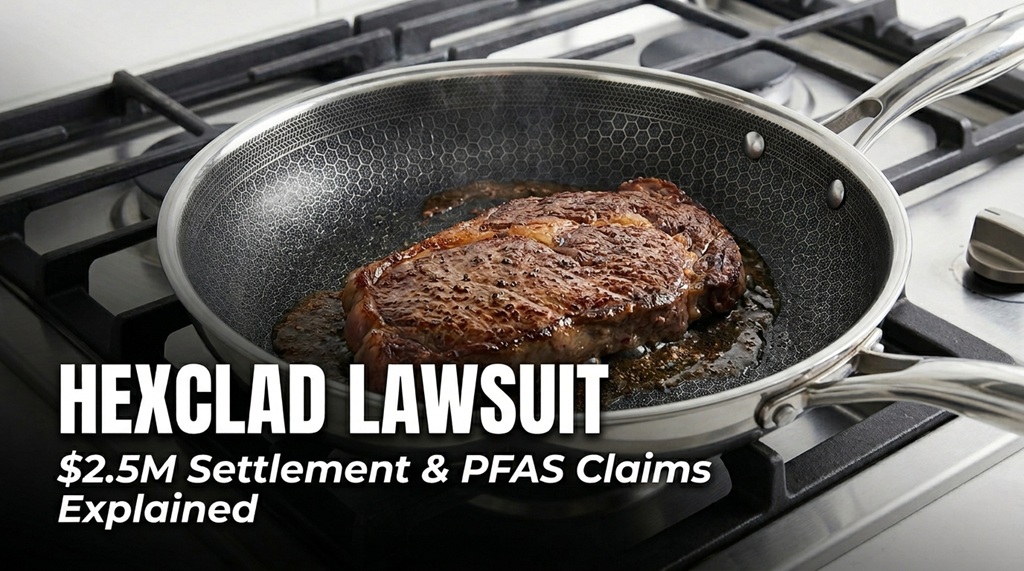
The HexClad lawsuit was a California class action that accused the cookware company of misleading consumers by marketing certain PTFE-coated products as “non-toxic,” “PFAS Free,” and “PFOA Free.” HexClad denied the allegations and did not admit wrongdoing. The lawsuit ended with a $2.5 million settlement, and the court granted final approval in 2026. The case focused on advertising practices rather than product defects or personal injuries, and no court ruled that HexClad cookware is unsafe to use.
Key Takeaways
- The lawsuit involved false advertising claims, not claims that HexClad cookware caused physical injuries.
- Plaintiffs alleged consumers paid a premium because of statements such as “PFAS Free,” “PFOA Free,” and “non-toxic.”
- HexClad denied violating the law and settled without admitting liability.
- The settlement created a $2.5 million fund for eligible consumers.
- The deadline to submit a claim has expired.
- Settlement payments began after final court approval in 2026.
- The settlement also required changes to certain future marketing statements for products covered by the agreement.
- No court concluded that HexClad cookware is dangerous or defective.
Quick Facts About the HexClad Lawsuit
| Topic | Information |
| Case Name | Cliburn v. One Source to Market, LLC d/b/a HexClad Cookware, Inc. |
| Case Number | 23STCV28390 |
| Court | Superior Court of California, County of Los Angeles |
| Defendant | One Source to Market LLC (HexClad Cookware) |
| Primary Allegation | False advertising and deceptive marketing |
| Settlement Amount | $2.5 million |
| Class Period | February 1, 2022, through March 31, 2024 |
| Final Approval | 2026 |
| Current Status | Settlement approved and payments distributed to eligible claimants |
| Claim Deadline | Closed |
| Admission of Wrongdoing | None |
What Is the HexClad Lawsuit?
The HexClad lawsuit is a consumer class action that challenged how the company advertised some of its nonstick cookware products. Rather than claiming the cookware caused injuries, the plaintiffs argued that HexClad’s marketing could have led reasonable consumers to believe the products were free from all PFAS-related materials.
According to the complaint, HexClad promoted certain cookware using phrases such as:
- “Non-toxic”
- “PFAS Free”
- “PFOA Free”
The plaintiffs argued these statements conflicted with the presence of polytetrafluoroethylene (PTFE), the fluoropolymer used in the cookware’s nonstick coating. Because many scientists classify PTFE within the broader PFAS family, the plaintiffs claimed consumers paid more for products marketed as chemically safer than competing nonstick cookware.
HexClad rejected these allegations throughout the litigation. The company maintained that its advertising complied with applicable law and chose to settle the case to avoid the expense, uncertainty, and disruption associated with prolonged litigation. Importantly, the settlement does not mean the court found HexClad liable, nor does it establish that the cookware is unsafe for normal household use.
Why Was HexClad Sued?
Consumers alleged that HexClad’s marketing overstated the chemical characteristics of its cookware, causing buyers to pay higher prices than they otherwise would have paid.
The Allegations Explained
The lawsuit centered on one question:
- Would a reasonable consumer understand “PFAS Free” to mean that the cookware contains no PFAS-related materials at all?
- The plaintiffs argued the answer was yes.
They alleged that consumers specifically purchased HexClad because the company promoted its cookware as:
- safer than traditional nonstick cookware,
- free from PFAS,
- free from PFOA,
- and non-toxic.
The complaint argued these representations increased consumer demand and allowed HexClad to charge premium prices. Instead of alleging burns, illnesses, or physical injuries, the plaintiffs claimed they suffered economic harm because they paid more for cookware they believed had different chemical properties. This type of claim is commonly known as a price-premium theory, where consumers argue they paid extra because of allegedly misleading advertising rather than because the product malfunctioned.
What Did the Plaintiffs Claim?
The lawsuit asserted several California consumer protection claims, including allegations under laws designed to prevent deceptive business practices and misleading advertising.
In general, the plaintiffs claimed that:
- HexClad advertised cookware using statements that could mislead consumers.
- Consumers reasonably relied on those statements when deciding to purchase the products.
- Buyers paid premium prices because of the advertised safety claims.
- The products contained PTFE despite marketing that emphasized being “PFAS Free” or “non-toxic.”
The plaintiffs sought financial relief for consumers who purchased the affected cookware during the class period. However, the lawsuit did not allege that HexClad cookware caused widespread physical injuries, nor did it ask the court to declare the products defective or ban their sale.
What Was HexClad’s Response?
HexClad consistently denied the allegations made in the lawsuit. The company disputed the plaintiffs’ interpretation of its advertising and denied violating consumer protection laws. It also denied that consumers were misled by its marketing. Like many companies involved in class action litigation, HexClad agreed to settle the case without admitting fault.
Similar consumer product settlements have followed a comparable path, including our coverage of the Quaker Oats Settlement, where the litigation also resolved through a negotiated agreement without requiring a full trial.
Settling a class action does not automatically indicate wrongdoing. Companies often choose settlement because it provides certainty, avoids years of litigation, and reduces the significant costs associated with continued legal proceedings. For that reason, the settlement agreement specifically states that it should not be interpreted as an admission of liability or unlawful conduct by HexClad.
Does HexClad Contain PFAS?
HexClad cookware uses a PTFE-based nonstick coating. PTFE is widely recognized as a fluoropolymer and is considered part of the broader PFAS family under many scientific definitions. The lawsuit focused on whether marketing the cookware as “PFAS Free” could mislead reasonable consumers, not on whether PTFE itself made the cookware unsafe.
This distinction became the central issue in the litigation.
Understanding PFAS, PTFE, and PFOA
These three terms are often confused, even though they refer to different things. Understanding the difference makes the HexClad lawsuit much easier to follow.
| Term | What It Is | Used in HexClad? |
| PFAS | A large family of thousands of fluorinated chemicals | PTFE belongs to this broader family under many scientific definitions |
| PTFE | A fluoropolymer commonly used as a nonstick coating | Yes |
| PFOA | A chemical once used during the manufacture of some PTFE products | Modern HexClad products are marketed as PFOA-free |
The lawsuit was not about whether PTFE exists in the cookware. HexClad has acknowledged that its cookware uses a PTFE-based nonstick coating. Instead, the dispute centered on whether products containing PTFE should have been advertised as “PFAS Free.”
What Are PFAS?
PFAS stands for per- and polyfluoroalkyl substances. Rather than describing one chemical, PFAS refers to a very large group containing thousands of fluorinated compounds.
Many PFAS chemicals are valued because they resist:
- Heat
- Water
- Oil
- Grease
- Stains
These properties make PFAS useful in many industries, including:
- Nonstick cookware
- Waterproof clothing
- Food packaging
- Firefighting foams
- Industrial manufacturing
Some PFAS compounds can remain in the environment for a long time, which is why they are sometimes called “forever chemicals.” However, not every PFAS chemical behaves the same way or presents the same environmental or health profile. Scientists and regulators continue studying individual PFAS compounds rather than treating every member of the group identically.
What Is PTFE?
PTFE stands for polytetrafluoroethylene. It is the material used to create the nonstick surface found on many modern cookware products, including HexClad’s hybrid cookware.
PTFE offers several practical benefits. It helps food release easily from the cooking surface. PTFE reduces the need for excessive cooking oil. It also improves scratch resistance when combined with HexClad’s stainless-steel lattice design.
At normal household cooking temperatures, PTFE has generally been regarded by regulatory authorities as suitable for food-contact applications when used as intended.
Research discussing PTFE often focuses on situations involving extreme overheating, such as leaving an empty pan on very high heat for an extended period. Those conditions differ from normal cooking practices.
What Is PFOA?
PFOA stands for perfluorooctanoic acid. Unlike PTFE, PFOA is not the coating itself. Historically, some manufacturers used PFOA during the production of certain fluoropolymer products. Over time, manufacturers largely phased out PFOA because of environmental and health concerns. As a result, many cookware products today are advertised as PFOA-free while still using PTFE as the nonstick coating.
That distinction became important in the HexClad litigation because consumers may interpret “PFOA Free” and “PFAS Free” differently.
Why Did the Advertising Become Controversial?
The lawsuit questioned whether reasonable consumers would understand the phrase “PFAS Free” to mean that the cookware contained no PFAS-related materials at all. The plaintiffs argued that many shoppers associate PFAS with a broad family of fluorinated chemicals.
Because PTFE is commonly classified within that family, they claimed advertising cookware containing PTFE as “PFAS Free” could create a misleading impression.
HexClad disagreed with that interpretation. The company maintained that its marketing complied with applicable law and denied misleading consumers. The court did not issue a ruling deciding which scientific interpretation was correct because the case settled before trial.
Did the Court Decide That HexClad Cookware Is Unsafe?
No. This is one of the biggest misconceptions surrounding the lawsuit.
The court did not determine that:
- HexClad cookware causes cancer.
- HexClad cookware is defective.
- HexClad cookware should be recalled.
- Consumers should stop using the products.
Instead, the lawsuit focused on advertising language and consumer purchasing decisions. The plaintiffs claimed they paid more because of marketing statements. The case did not establish that the cookware itself caused physical harm. This distinction is important because many online discussions incorrectly describe the lawsuit as a product safety case. It was primarily a consumer advertising dispute.
What Did the Court Actually Decide?
The case ended through a negotiated settlement before a trial verdict.
That means:
- No judge ruled that HexClad violated consumer protection laws.
- No jury determined that the company committed false advertising.
- No court concluded the cookware was unsafe.
Instead, the parties reached an agreement that resolved the litigation without requiring either side to prove its claims at trial. This type of resolution is common in class action litigation because it avoids years of additional legal proceedings and uncertainty for both parties.
What Did the $2.5 Million Settlement Include?
The settlement created a $2.5 million common fund to resolve the claims brought on behalf of eligible consumers. According to the settlement agreement, the fund covered several categories of payments.
These included:
- Cash payments to eligible class members.
- Court-approved attorneys’ fees.
- Litigation expenses.
- Settlement administration costs.
- Service awards for the class representatives.
Each approved claimant received a pro rata payment, meaning the amount depended on several factors rather than a fixed dollar figure.
These factors included:
- The number of eligible products purchased.
- Whether proof of purchase was available when required.
- The purchase price.
- The total number of valid claims submitted.
Because payments were calculated on a proportional basis, consumers did not all receive the same amount.
What Changed After the Settlement?
One of the most significant parts of the settlement was not the money. It was the agreement to change certain advertising practices. Under the settlement, HexClad agreed to stop using specific marketing statements for products covered by the agreement when those statements could conflict with the product’s composition.
The settlement addressed phrases including:
- “PFAS Free”
- “PFOA Free”
- “Non-toxic”
for products containing PTFE or other PFAS-family chemicals covered by the agreement. These advertising changes were intended to reduce the likelihood of future consumer confusion while allowing the lawsuit to be resolved without further litigation. The settlement does not prohibit HexClad from selling its cookware, and it does not require the company to recall existing products.
Consumer protection settlements frequently require companies to modify their business practices or marketing. A similar approach appeared in the Amazon Prime Subscription Refund FTC Settlement, where the resolution focused on subscription disclosures and cancellation practices.
Why the Advertising Changes Matter
For many consumers, the advertising provisions may have a greater long-term impact than the cash payments. Companies frequently settle consumer class actions by agreeing to revise labels, website language, or marketing materials. These changes can influence how products are described in the future and may provide clearer information to shoppers comparing cookware options.
In the HexClad case, the settlement sought to address the disputed advertising language while avoiding a lengthy courtroom battle over scientific terminology and consumer interpretation.
Can You Still File a HexClad Settlement Claim?
No. The deadline to submit a claim in the HexClad class action has passed. Consumers who did not file a valid claim before the deadline are generally not eligible to receive a settlement payment.
The claims process has closed, and the settlement administrator is no longer accepting new claim submissions.
Who Was Eligible for the Settlement?
The settlement covered consumers who purchased eligible HexClad cookware during the approved class period.
Generally, a person is qualified if they:
- Purchased eligible HexClad cookware in the United States.
- Bought the product during the class period.
- Submitted a valid claim before the deadline.
- Met the requirements established in the settlement agreement.
Consumers who purchased products after the class period or failed to submit a timely claim were generally not eligible to receive compensation.
Which Products Were Included?
The settlement covered qualifying HexClad cookware sold during the class period. Eligible purchases included products sold directly by HexClad as well as authorized retailers, including major online marketplaces.
The settlement administrator reviewed submitted claims according to the terms approved by the court.
Was Proof of Purchase Required?
It depended on how many products a claimant reported.
Under the settlement:
| Situation | Proof of Purchase |
| One or two eligible products | Generally not required |
| Three or more eligible products | Required |
When proof was required, claimants could submit documents such as:
- Order confirmations
- Retail receipts
- Online purchase history
- Account records from participating retailers
These documents helped verify both eligibility and purchase amounts.
How Much Money Did Consumers Receive?
There was no fixed payment amount for every claimant. Instead, payments were calculated on a pro rata basis, meaning each person’s payment depended on several factors.
These included:
- Number of qualifying products
- Purchase price
- Whether proof of purchase was submitted when required
- Total number of valid claims approved
Because every claim was different, settlement payments varied among class members. Several news reports estimated that many consumers could receive relatively modest payments, but the final amount depended on the overall claims process rather than a guaranteed dollar figure.
Why Didn’t Everyone Receive the Same Amount?
Many class action settlements work differently from rebate programs. Instead of paying everyone an identical amount, the available settlement fund is divided among approved claimants according to the court-approved allocation formula. For the HexClad settlement, several variables affected individual payments.
Someone who purchased multiple qualifying cookware items with documented purchase prices could receive a different payment than someone who claimed only one eligible product without documentation.
How Was the $2.5 Million Settlement Fund Used?
The settlement fund covered more than consumer payments. It also paid for the costs associated with resolving the lawsuit.
According to the settlement documents, the fund included:
| Purpose | Description |
| Consumer Payments | Cash payments to approved claimants |
| Attorneys’ Fees | Court-approved legal fees |
| Litigation Expenses | Costs incurred during the lawsuit |
| Administration Costs | Processing claims and distributing payments |
| Service Awards | Compensation approved for class representatives |
This structure is common in consumer class action settlements.
Are Settlement Payments Being Sent?
Current Status
Yes. Following final court approval, the settlement administrator began distributing payments to eligible claimants. Consumers whose claims were approved received payment according to the settlement terms.
Individuals who did not receive payment may have experienced issues such as:
- An incomplete claim
- Ineligibility under the settlement
- Payment delivery problems
- Incorrect contact information
- Banking or mailing issues
Consumers with questions about their individual claim should contact the official settlement administrator rather than relying on unofficial websites or social media discussions.
What If You Missed the Claim Deadline?
Unfortunately, consumers who missed the filing deadline generally cannot participate in the settlement.
Courts establish claim deadlines to allow settlement administrators to:
- Verify claims
- Calculate payments
- Finalize distributions
- Close the litigation
Once the deadline passes and the settlement becomes final, late claims are typically not accepted unless the court orders otherwise. As of the latest public updates, no additional filing period has been announced.
What Happens If Your Claim Was Denied?
Not every submitted claim automatically qualified for payment.
Claims could be rejected for several reasons, including:
- Missing required information
- Duplicate submissions
- Incomplete documentation
- Failure to satisfy settlement requirements
- Purchases outside the approved class period
Some claimants were allowed to correct deficiencies during the claims review process if permitted by the settlement administrator. After the review process concluded, approved claims proceeded to payment.
How Long Did the Settlement Process Take?
Consumer class actions often require several years to resolve. The HexClad litigation followed a timeline similar to many nationwide consumer settlements.
The process included:
- Filing the complaint
- Litigation and negotiations
- Preliminary court approval
- Notice to consumers
- Claims period
- Final approval hearing
- Distribution of settlement payments
Although the settlement fund totaled $2.5 million, completing the legal process required multiple stages over several years.
Court Approval Process
Before the settlement became effective, the Los Angeles Superior Court granted preliminary approval on April 22, 2025, allowing notice to be sent to class members and the claims process to begin. The court scheduled a final approval hearing for September 15, 2025, to determine whether the settlement was fair, reasonable, and adequate.
According to subsequent settlement updates, the settlement was ultimately approved, and eligible claimants later began receiving payments.
HexClad Lawsuit Timeline
Understanding the timeline helps explain how the lawsuit progressed from the original complaint to settlement payments.
| Date | Event |
|---|---|
| February 1, 2022 | Beginning of the class period |
| June 27, 2023 | First federal lawsuit (Didwania action) filed |
| November 17, 2023 | Cliburn action filed in the Los Angeles Superior Court |
| December 22, 2023 | Cases consolidated through the amended complaint |
| April 22, 2025 | The court granted preliminary approval of the proposed settlement |
| June 6, 2025 | Notice program began |
| August 5, 2025 | Deadline to opt out or object |
| September 15, 2025 | Final approval hearing scheduled |
| November 14, 2025 | Claim submission deadline |
| After final approval | Settlement became effective, and payments were distributed to eligible claimants |
Current Status of the HexClad Lawsuit (June 2026)
The lawsuit has been resolved through a court-approved settlement.
Here is the current status:
- The settlement received final court approval.
- The claims period has ended.
- New claims are no longer being accepted.
- Eligible consumers have begun receiving settlement payments.
- HexClad continues selling its cookware.
- No court determined that HexClad cookware is unsafe.
- The settlement resolved disputed advertising claims without any admission of wrongdoing by the company.
For most consumers, the case is now in the post-settlement administration phase rather than active litigation.
Is HexClad Cookware Safe to Use?
Based on the publicly available evidence, no court has ruled that HexClad cookware is unsafe. The lawsuit focused on advertising claims rather than product safety. It did not conclude that HexClad cookware causes illness, cancer, or other health problems when used as intended.
Like many nonstick cookware products, HexClad uses a PTFE-based coating. Regulatory agencies permit PTFE for food-contact applications when products are manufactured and used according to applicable standards.
Why Do Some People Worry About HexClad?
The concerns usually relate to three topics:
- PTFE
- PFAS
- High-temperature cooking
These issues are often discussed together online, even though they are not the same. The lawsuit itself did not claim that HexClad cookware caused widespread injuries. Instead, it questioned whether certain marketing statements accurately described cookware containing PTFE. As a result, many online discussions have confused a false advertising lawsuit with a product safety lawsuit. They are different.
Does the Lawsuit Mean HexClad Is Dangerous?
No. A settlement does not prove that a product is dangerous.
In this case:
- No court ruled that HexClad cookware is defective.
- No court ordered a product recall.
- No government agency banned HexClad cookware.
- No judge found the cookware unsafe.
Instead, the lawsuit ended through a negotiated settlement that resolved disputed advertising claims without requiring a trial. This distinction is important because settlement agreements often resolve litigation without either side admitting liability or proving its allegations.
Should You Stop Using HexClad Cookware?
For most consumers, there is no legal or regulatory requirement to stop using HexClad cookware.
The lawsuit did not result in:
- A recall
- A safety warning
- A product ban
- Instructions for consumers to discard their cookware
Consumers who already own HexClad cookware can generally continue using it according to the manufacturer’s care and cooking instructions.
However, people who personally prefer cookware without fluoropolymer-based coatings may choose alternatives such as ceramic, stainless steel, or cast iron based on their own preferences. That is a personal purchasing decision rather than a requirement created by the lawsuit.
What Happens if PTFE Gets Too Hot?
One topic frequently discussed in scientific literature is extreme overheating. Most research involving PTFE focuses on situations where cookware reaches unusually high temperatures, such as leaving an empty pan on high heat for extended periods. These conditions differ significantly from normal cooking.
For everyday cooking, manufacturers generally recommend:
- Avoid preheating an empty pan for long periods.
- Use moderate cooking temperatures when appropriate.
- Follow the manufacturer’s care instructions.
- Replace cookware if the nonstick surface becomes significantly damaged over time.
These are general recommendations for many types of nonstick cookware and are not unique to HexClad.
Is HexClad Better Than Traditional Nonstick Cookware?
HexClad differs from many traditional nonstick pans because it combines:
- Stainless steel
- PTFE-based nonstick coating
- A laser-etched hybrid cooking surface
The stainless-steel lattice is designed to provide greater durability than some conventional nonstick cookware while maintaining food-release performance. Whether it is “better” depends on what a consumer values most. Someone prioritizing easy cleanup may prefer hybrid nonstick cookware. Someone wanting cookware without fluoropolymer coatings may prefer ceramic, stainless steel, or cast iron.
HexClad vs. Ceramic vs. Stainless Steel
| Feature | HexClad | Ceramic | Stainless Steel |
| Nonstick Performance | Excellent | Good | Low without oil |
| PTFE Coating | Yes | No | No |
| PFAS-Free Surface | No (PTFE-based) | Yes | Yes |
| Scratch Resistance | High | Moderate | Excellent |
| Dishwasher Safe | Generally Yes | Varies | Usually Yes |
| Metal Utensils | Designed for limited metal utensil use | Usually Not Recommended | Yes |
| Maintenance | Low | Moderate | Moderate |
Each material has strengths and trade-offs. No single cookware type is ideal for every kitchen.
Common Myths About the HexClad Lawsuit
Because the lawsuit received significant online attention, several misconceptions continue circulating.
Myth: HexClad Was Recalled
Fact: No nationwide recall resulted from this lawsuit.
Myth: The Court Found HexClad Unsafe
Fact: No court made that finding.
The lawsuit focused on advertising claims rather than product safety.
Myth: HexClad Admitted It Lied
Fact: No.
HexClad denied wrongdoing and settled without admitting liability.
Myth: Anyone Can Still Receive Settlement Money
Fact: No.
The deadline to submit claims has already passed.
Myth: PTFE and PFOA Are the Same Thing
Fact: They are different.
PTFE is the nonstick fluoropolymer coating. PFOA is a separate chemical that was historically used in manufacturing certain fluoropolymer products.
Myth: Every PFAS Chemical Has the Same Risk
Fact: No. PFAS refers to a very large group of chemicals. Scientists and regulators evaluate individual PFAS compounds separately because their properties and potential risks can differ.
What This Settlement Does and Does Not Mean
One of the easiest ways to understand the case is to separate what the settlement actually resolved from what it did not.
| The Settlement Did | The Settlement Did Not |
| Resolve false advertising claims | Declare HexClad cookware unsafe |
| Provide compensation to eligible consumers | Require a product recall |
| Require changes to certain marketing statements | Ban HexClad products |
| End the litigation without a trial | Prove consumers suffered physical injuries |
| Resolve disputed consumer claims | Require HexClad to admit wrongdoing |
Understanding these distinctions helps consumers evaluate news reports and online discussions more accurately.
Should You Buy HexClad Today?
The lawsuit does not answer that question.
Instead, consumers should consider factors such as:
- Cooking style
- Budget
- Desired durability
- Preference for nonstick performance
- Preference regarding fluoropolymer-based coatings
- Ease of cleaning
- Long-term maintenance
Some buyers value the hybrid cooking surface and durability. Others prefer cookware made entirely from stainless steel, cast iron, or ceramic because of their material preferences. Ultimately, choosing cookware is a personal decision that depends on individual priorities rather than the outcome of this lawsuit.
Consumer Checklist Before Buying Any Nonstick Cookware
Whether you are considering HexClad or another brand, it is helpful to review:
- What coating is used?
- Is the cookware intended for high-heat cooking?
- Is it compatible with your stovetop?
- Are replacement warranties available?
- What do independent product tests say?
- What do the manufacturer’s care instructions recommend?
These questions are often more useful than relying on advertising claims alone.
FAQs
What Is the HexClad Controversy?
The HexClad controversy involves claims that the company marketed PTFE-coated cookware as “PFAS Free,” “PFOA Free,” and “non-toxic.” Consumers alleged these claims were misleading, while HexClad denied wrongdoing. The lawsuit ended with a $2.5 million settlement.
Is HexClad Safe or Toxic?
No court has found HexClad cookware to be unsafe or toxic. The lawsuit focused on advertising claims rather than product safety, and the cookware continues to be sold.
When Did HexClad Stop Using PTFE Coating?
There is no public evidence that HexClad has stopped using PTFE coatings. The settlement addressed certain marketing claims but did not require the company to remove PTFE from its cookware.
Is There Really a HexClad Lawsuit?
Yes. Consumers filed a class action alleging misleading advertising related to HexClad’s cookware. The case ended in a court-approved $2.5 million settlement, with HexClad denying all allegations and admitting no wrongdoing.
Why was HexClad sued?
Consumers claimed HexClad advertised some PTFE-coated cookware as “PFAS Free,” “PFOA Free,” and “non-toxic,” even though the products contained PTFE. They argued these statements caused consumers to pay premium prices. HexClad denied the claims.
Did HexClad admit wrongdoing?
No. The settlement specifically states that HexClad denied liability and did not admit violating any law.
Is PTFE the same as PFOA?
No. PTFE is the nonstick fluoropolymer coating used on cookware. PFOA is a different chemical that was historically used in manufacturing certain fluoropolymer products.
What products qualified?
Eligible HexClad cookware purchased during the approved class period qualified under the settlement terms.
Did Gordon Ramsay get sued?
No. Although Gordon Ramsay has promoted HexClad cookware, he was not named as a defendant in this lawsuit.
Did the government ban HexClad?
No. No government agency banned HexClad cookware because of this lawsuit.
What Consumers Should Remember
If you only remember a few things about the HexClad lawsuit, these are the most important:
- The lawsuit involved advertising claims, not product defect claims.
- No court ruled that HexClad cookware is unsafe.
- HexClad denied wrongdoing.
- The parties resolved the case through a $2.5 million settlement.
- The claims deadline has expired.
- Eligible consumers have begun receiving settlement payments.
- The settlement also required changes to certain future advertising statements.
Final Thoughts
The HexClad lawsuit became one of the most widely discussed cookware class actions because it raised questions about how companies describe products containing PTFE and how consumers interpret terms such as “PFAS Free,” “PFOA Free,” and “non-toxic.” Although the lawsuit ended with a $2.5 million settlement, it is important to understand what the resolution does and does not mean.
The settlement resolved disputed advertising claims without requiring a trial or an admission of wrongdoing. It did not establish that HexClad cookware is defective, unsafe, or responsible for consumer injuries. For consumers, the case serves as a reminder that marketing language, scientific terminology, and legal standards do not always align. Understanding those differences can help shoppers make more informed purchasing decisions and better evaluate claims made about cookware and other consumer products.
This article provides general informational content about the HexClad class action lawsuit. Case information is sourced from court records (Case No. 23STCV28390, L.A. Superior Court), the official settlement website (HexCladSettlement.com), and verified legal news sources. Nothing in this article constitutes legal, medical, or financial advice.

Sadia Parveen is a content writer at ClassAction24.com who creates informational articles on class action lawsuits, consumer protection matters, and legal developments. Her work focuses on researching public court records, official filings, and reputable news sources, then presenting it in a clear and neutral format for general readers. Her articles follow the ClassAction24.com editorial policy and are reviewed by an editor before publication. She does not provide legal advice or professional legal services.