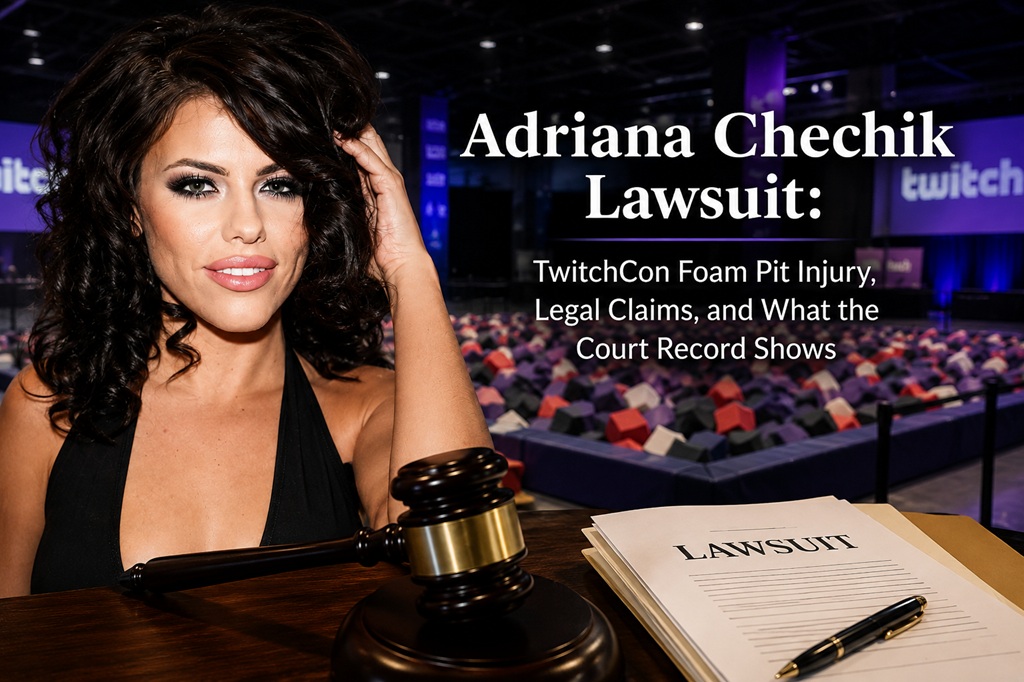
Adriana Chechik Lawsuit: TwitchCon Foam Pit Injury, Legal Claims, and What the Court Record Shows
Adriana Chechik broke her back in two places at TwitchCon San Diego on October 8, 2022, after jumping into a dangerously shallow foam pit at a booth co-sponsored by Lenovo Legion and Intel. She underwent emergency spinal surgery, sustained nerve damage, and lost a pregnancy as a direct result of the incident. As of June 2026, no confirmed public lawsuit or verified settlement has appeared in accessible San Diego Superior Court or federal court records. Legal analysts widely believe the parties reached a confidential private settlement before any public filing occurred.
Four years later, articles claiming a $28 million class action settlement, open claims processes, and verified court filings flood the search results. Most of those claims do not hold up to scrutiny.
This article separates what public records confirm from what remains speculation — and explains what the legal landscape actually looked like for everyone injured at that foam pit.
What Is the Adriana Chechik Lawsuit?
The Adriana Chechik lawsuit refers to a personal injury matter arising from a serious spinal injury she sustained at TwitchCon San Diego in October 2022. The incident occurred at an interactive exhibit operated by Lenovo Legion and Intel, where a foam pit concealed bare concrete beneath a shallow layer of foam cubes. Chechik broke her back in two places, required emergency surgery, and suffered long-term nerve damage.
The case draws public attention because it raises foundational questions in U.S. personal injury law — specifically, who bears legal responsibility when a corporate sponsor operates a physically dangerous activity inside an event organized by a separate company, and whether signed injury waivers can shield defendants from claims of gross negligence under California law.
Search interest in the Adriana Chechik lawsuit remains high because widely circulated online articles make specific claims about settlement amounts and court filings that are not supported by verified public court records. This article distinguishes between confirmed facts and unverified claims.
What Happened at TwitchCon San Diego?
TwitchCon 2022 ran from October 7–9 at the San Diego Convention Center. Organized by Twitch Interactive — the Amazon-owned livestreaming platform — the annual convention featured gaming showcases, brand activations, and interactive experiences for thousands of attendees.
One of the featured installations was a joint marketing activation by Lenovo Legion and Intel. The setup replicated an “American Gladiators”-style competition: two participants stood on raised platforms suspended above a foam pit and competed using padded foam swords. Losers were knocked out. Winners typically jumped in voluntarily to celebrate. The exhibit required participants to sign an injury waiver before competing.
On October 8, 2022 — the second day of the convention — Adriana Chechik competed against fellow streamer EdyBot. After winning her round, Chechik jumped from the platform to celebrate. She landed tailbone-first on what appeared to be foam cubing but was, in fact, a shallow layer of foam over bare concrete. Footage of the incident spread rapidly across social media within hours.
An announcer’s voice is audible in the widely circulated video: “No, no, she’s fine.” She was not fine. Critically, the pit had already caused injuries on day one of the convention. Multiple attendees reported injuries before Chechik participated. The exhibit was nonetheless reopened for the second day without verified remediation.
Adriana Chechik’s Injuries — Full Medical Overview
Chechik’s injuries were catastrophic by any clinical measure. She suffered fractures at two locations in her lumbar spine — reported as the L1 and L2 vertebrae — a region critical to lower-body motor function, bladder control, and sensory response. She underwent emergency spinal fusion surgery that same day, including insertion of a metal rod to stabilize the fracture site. Medical reporting confirmed the injury produced nerve damage affecting bladder function, a known complication of lumbar vertebral fractures at that spinal level.
On October 29, 2022, it was reported that Chechik had been pregnant at the time of the incident. The pregnancy had to be terminated because the life-saving spinal surgery could not safely proceed otherwise. Chechik publicly confirmed this.
Recovery extended across multiple years:
- November 2022: Chechik live-streamed to discuss her condition, described recovery as ongoing, and asked fans to stop tagging her in content demanding legal action against the companies involved.
- November 2023: She publicly disclosed she was still experiencing pain more than a year post-surgery.
- November 2025: Chechik announced she had resumed professional work after completing extensive physical therapy, including treatment specifically aimed at restoring neurological function affected by the spinal injury.
The medical trajectory reflects the severity of lumbar spinal trauma. According to the American Association of Neurological Surgeons, spinal fractures at the L1–L2 level carry a significant risk of long-term complications even with surgical intervention.
Who Else Was Injured at the Foam Pit?
Adriana Chechik was not the only person harmed by the exhibit. Streamer LochVaness suffered a knee dislocation at the same foam pit on Saturday — the day before Chechik’s injury. After winning her round, LochVaness jumped off the platform and immediately suffered an ankle roll that shifted her kneecap out of position. She told NBC News: “Once I had jumped off and my foot hit the bottom and my ankle rolled, and then my kneecap was on the side. I couldn’t move.”
Medical staff at the venue put her kneecap back into place. She subsequently required specialist evaluation, an MRI scan, and sports medicine rehabilitation. In a statement following the incident, LochVaness said directly: “All these injuries could have been avoided if the floor underneath all the foam wasn’t pure concrete. This was not safe.”
Streamer EdyBot — who competed directly against Chechik — disclosed to Rolling Stone that she had not been told someone was injured before their round. At least one additional unidentified participant was photographed in visible distress at the exhibit. Reports from multiple attendees confirmed the pit remained operational between injury incidents. The multi-victim pattern is legally significant. It supports a negligence argument that the dangerous condition was known to operators before Chechik was injured.
Who Is Legally Responsible? Defendant Breakdown
Premises liability in multi-sponsor event settings is rarely simple. At least four distinct parties had operational involvement with the TwitchCon foam pit:
Lenovo Legion operated the booth. Lenovo issued the only public corporate statement regarding the injuries, telling Rolling Stone on October 9, 2022: “We are aware of the incidents of TwitchCon visitors who sustained injuries in the gladiator game soft foam pit at the Lenovo booth. The area has since been closed for any further use while we work with event organizers to look into the incidents.” Lenovo’s promotional materials actively encouraged attendees to participate in “pit dives.”
Intel co-sponsored the activation as part of a joint marketing agreement with Lenovo. Both companies held promotional interest in the exhibit and contributed to the branded setup.
Twitch Interactive organized TwitchCon, leased the San Diego Convention Center for the event, and approved all vendor booth installations. The American video live-streaming serviceplatform bore responsibility as the primary event organizer, regardless of which sponsor operated individual exhibits. Twitch issued no public statement at any point regarding the injuries.
The San Diego Convention Center served as the physical venue for the exhibit. In premises liability cases, venue operators can face exposure when they have knowledge of dangerous conditions on their premises.
Under California law, all parties with operational control over an activity or property can face legal exposure. The contractual relationships between Lenovo, Intel, and Twitch — specifically any indemnification clauses in their exhibitor agreements — would determine how the parties apportion ultimate liability internally, but those agreements do not eliminate public-facing legal exposure.
Twitch Interactive organized TwitchCon and approved all vendor booth installations. Similar questions of corporate liability and duty of care have emerged in other cases involving performers, including the Phoenix Marie Lawsuit.
Can a Waiver Block a Lawsuit Under California Law?
Participants signed injury waivers before competing at the Lenovo exhibit. Twitch pointed to these waivers when questions of liability arose. Under California law, the enforceability of those waivers is not absolute.
The California Supreme Court addressed this directly in City of Santa Barbara v. Superior Court (2007). The court confirmed that waivers of liability are unenforceable against claims of gross negligence — defined under California law as “want of even scant care” or “an extreme departure from the ordinary standard of conduct.”
The factual record here presents a strong argument for gross negligence, not just ordinary negligence:
- The pit depth was approximately two feet. Industry safety standards for similar activities recommend a minimum of six to eight feet of foam depth to prevent impact injuries.
- The exhibit was opened on day two after multiple injuries had already been reported on day one.
- Lenovo’s own promotional materials encouraged the “pit dive” activity without apparent safety warnings about the concrete base.
- Announcer behavior following Chechik’s visible injury — telling observers she was fine as she lay unable to move — suggests inadequate safety oversight at the ground level.
A waiver can protect defendants from claims arising from ordinary carelessness. It cannot, under California law, shield a defendant who operated a known dangerous condition and allowed participants to continue using it after prior injuries.
Waivers do not automatically protect defendants from gross negligence claims. A similar legal question arose in the Janice Griffith Lawsuit, where a staged stunt resulted in injury and raised comparable questions about liability and consent.
Premises Liability Law and the TwitchCon Foam Pit
The Adriana Chechik case fits squarely within the established framework of California premises liability law, which governs the duty of care owed to visitors of a property or event. Under the California Civil Code, property owners and event operators owe visitors a duty to maintain reasonably safe conditions and to warn of known hazards. This duty applies to all parties with legal or operational control over the premises — not just the legal title holder.
The relevant legal theory for this case is negligence-based premises liability, with the following elements applicable to the facts:
- Duty: Lenovo, Intel, Twitch, and the Convention Center each owed a duty of reasonable care to participants.
- Breach: Operating a foam pit with a depth far below safety standards constitutes a breach of that duty. Allowing the pit to remain operational after day-one injuries may elevate the breach to gross negligence.
- Causation: The defective pit design was the direct and proximate cause of Chechik’s spinal fractures.
- Damages: Spinal surgery, nerve damage, pregnancy loss, and multi-year recovery create a documented damages profile.
Under California Civil Code Section 1431.2, defendants in personal injury cases are severally liable for non-economic damages in proportion to their respective fault. They may also seek contributions from each other through indemnification provisions in their private agreements. The statute of limitations for personal injury claims in California is two years from the date of injury — placing the relevant filing window between October 2022 and October 2024.
Did Adriana Chechik File a Lawsuit?
As of June 2026, no confirmed public lawsuit filed by Adriana Chechik appears in accessible California court records. Independent searches of San Diego Superior Court dockets and federal court records in the Southern District of California — conducted by NBC News, PC Gamer, and legal reporters — have not identified a civil complaint tied directly to Chechik by name.
The absence of a public court record does not confirm that no legal action was taken. It means no action was entered into the public record. There are two common explanations for this:
- Pre-litigation settlement
The overwhelming majority of serious personal injury claims settle confidentially before a formal complaint is filed. A settlement reached during private negotiations — or during pre-litigation mediation — would leave no public court record.
- Demand letter resolution:
Attorneys frequently resolve high-value personal injury matters by sending a formal demand letter to defendants’ legal teams. If the parties reach an agreement at that stage, no lawsuit is ever filed publicly.
Chechik’s behavior following the incident is consistent with confidential legal proceedings. During her November 2022 live stream — her first public appearance post-surgery — she notably made no mention of legal action and asked fans to stop tagging her in posts demanding corporate accountability. PC Gamer observed at the time that this silence was consistent with active settlement discussions occurring outside the public record.
Is There a Settlement? Verified vs Unverified Claims
Several widely indexed articles make specific and detailed claims about an Adriana Chechik settlement, including a $28 million settlement fund, a January 2026 claims process, and a November 2025 mediation. These claims are not supported by any verifiable court filing, settlement administrator notice, or official legal document reviewed for this article.
What is confirmed:
- Injuries occurred on October 8, 2022, at TwitchCon San Diego.
- Lenovo confirmed the exhibit was closed following injuries.
- No public complaint appears in San Diego Superior Court or federal court records.
- Legal analysts broadly agree that a private settlement is the most likely explanation for the absence of public litigation.
- California’s two-year statute of limitations for personal injury claims expired in October 2024.
What is not confirmed:
- Any specific settlement dollar amount.
- Any class-wide settlement fund.
- Any open claims process for TwitchCon 2022 attendees.
- Any verified mediation date or trial setting.
Readers researching this topic should apply the same standard used to evaluate any legal claim: does the source cite a case number, a court, a docket entry, or a settlement administrator? Without those anchors, the claims are speculation, not reporting.
How Twitch, Lenovo, and Intel Responded
Journalists and legal commentators widely noted the corporate responses — and non-responses — that followed the TwitchCon foam pit injuries.
Lenovo
issued a statement to Rolling Stone on October 9, 2022, acknowledging the injuries and confirming the exhibit had been closed. No other defendant issued any substantive public statement.
Intel
Made no public statement. Booth branding and promotional materials confirmed Intel’s involvement as co-sponsor — not any voluntary corporate disclosure.
Twitch
Issued no public statement at any point. Twitch’s official social media channels continued posting positive TwitchCon content after the injuries became public. The company did not acknowledge Chechik’s injury in any observable public channel. Chechik confirmed Twitch never contacted her privately either. The company denied liability by pointing to Lenovo’s operational control of the booth and the signed waivers.
Legal commentators noted that Twitch’s complete public silence was legally strategic — any acknowledgment of the incident could have been used as an admission in subsequent proceedings.
What California Law Says About Event Organizer Liability
Twitch’s position — that Lenovo and Intel organized the exhibit and therefore bear exclusive responsibility — does not align well with California’s established approach to multi-party event liability. California courts have consistently held that event organizers cannot fully insulate themselves from liability simply by contracting out dangerous activities to third-party sponsors. The organizing entity retains a duty of care to attendees for activities that occur within its event, on premises it controls.
The relevant legal principle is the non-delegable duty doctrine: certain duties of care cannot be transferred to independent contractors through private agreements. An event organizer that approves an exhibit featuring physical risk-taking activities retains a duty to ensure those activities meet reasonable safety standards — regardless of which corporate entity physically operates the exhibit.
California appellate courts reinforced this principle in decisions addressing amusement parks, trade shows, and convention spaces where injuries occurred during third-party-operated attractions. A sponsor’s operational control does not eliminate the organizing entity’s duty of care.
Twitch’s argument that it bore no responsibility because Lenovo and Intel ran the booth would face significant scrutiny under this framework.
Impact on Convention Safety Standards
The TwitchCon 2022 foam pit incident produced observable changes in how major gaming and entertainment conventions approach vendor activation safety. Following the incident, multiple convention organizers adopted or strengthened requirements for physical interactive exhibits, including mandatory third-party safety inspections, minimum depth specifications for pit-style installations, and prohibitions on reopening attractions following injury reports without independent clearance.
Insurance industry analyses reported premium increases for conventions featuring physical interactive exhibits in the year following the TwitchCon incident. Gaming and entertainment convention organizers increasingly require vendors to certify compliance with applicable safety standards before approving any physical activity installation. Major gaming conventions reported no comparable foam pit injuries in 2023 or 2024, suggesting the industry response produced measurable safety improvements.
Platform companies face growing legal scrutiny across multiple contexts. The Grok AI Deepfake Lawsuit 2026 reflects a parallel pattern of corporate silence followed by legal accountability demands.
Key Facts at a Glance
| Detail | Verified Status |
|---|---|
| Date of incident | October 8, 2022 |
| Location | TwitchCon San Diego, San Diego Convention Center |
| Exhibit operators | Lenovo Legion and Intel (confirmed — Lenovo statement, Rolling Stone, NBC News) |
| Injuries sustained | L1–L2 spinal fractures, rod implant surgery, nerve damage, pregnancy termination (confirmed — Chechik public statements, medical reporting) |
| Other victims | LochVaness (knee dislocation), multiple unnamed attendees (confirmed — NBC News, Rolling Stone) |
| Pit depth | Approximately 2 feet over bare concrete (confirmed — multiple media reports) |
| Industry safety standard | 6–8 feet minimum foam depth for similar activities |
| California limitations period | Two years from injury date — expired October 2024 |
| Public lawsuit in court records | Not confirmed in accessible California court databases as of June 2026 |
| $28M settlement fund | Not confirmed in any verified court filing or settlement administrator notice |
| Twitch public response | None issued (confirmed) |
| Lenovo’s public response | Statement issued October 9, 2022 (confirmed — Rolling Stone) |
| Applicable legal doctrine | California premises liability: gross negligence exception to waiver enforceability |
FAQs
Did Adriana Chechik ever recover?
Yes. Adriana Chechik has largely recovered, though the process took over three years. After breaking her back in two places at TwitchCon San Diego in October 2022, she underwent emergency spinal fusion surgery and years of physical therapy, including specialized treatment for nerve damage that affected sensory function. By November 2025, she confirmed she had resumed professional work. She has not publicly stated she is fully pain-free, and the spinal hardware from her surgery remains in place.
What is the Adriana Chechik lawsuit about?
The Adriana Chechik lawsuit refers to a personal injury matter arising from a serious spinal injury she suffered at TwitchCon San Diego on October 8, 2022. She broke her back in two places after jumping into a foam pit that was only about two feet deep over bare concrete at a booth co-operated by Lenovo Legion and Intel.
Did Adriana Chechik sue Twitch or Lenovo?
As of June 2026, no confirmed public lawsuit appears in California court records. Legal analysts widely believe the parties negotiated a confidential private settlement before any complaint entered the public record, which explains the absence of public court filings.
What injuries did Adriana Chechik suffer at TwitchCon?
Chechik suffered fractures at the L1 and L2 vertebrae, underwent emergency spinal fusion surgery with a metal rod implant, sustained nerve damage affecting bladder function, and lost a pregnancy because the surgery could not proceed otherwise. Her recovery included several years of physical therapy.
Is there a $28 million settlement from the TwitchCon foam pit?
Several online articles cite this figure, but no verifiable court filing, settlement administrator notice, or official document supports it. As of June 2026, no confirmed open claims process exists.
Did signed waivers prevent Adriana Chechik from suing?
Not necessarily. Under California law, as confirmed in City of Santa Barbara v. Superior Court, waivers cannot shield defendants from gross negligence claims. Operating a foam pit far below safety depth standards — after receiving injury reports on the first day of the event — is a fact pattern that could support a gross negligence argument.
Who was responsible for the TwitchCon foam pit?
Lenovo Legion and Intel operated the exhibit. Twitch Interactive organized TwitchCon and approved vendor installations. The San Diego Convention Center provided the venue. Under California premises liability law, all parties with operational control over the activity can face legal exposure.
Was Adriana Chechik the only person injured?
No. Streamer LochVaness dislocated her knee at the same pit on the day before Chechik’s injury. Multiple other unnamed attendees reported injuries from the same exhibit. The pit was reopened on day two despite day-one injuries.
What is Adriana Chechik doing now?
As of November 2025, Chechik publicly confirmed she had resumed professional work following years of recovery and physical therapy. She had previously disclosed that nerve damage from the spinal injury required targeted treatment before she could resume normal function.
All factual claims in this article are based on primary reporting from NBC News, Rolling Stone, The Washington Post, Kotaku, Gizmodo, HuffPost, and PC Gamer; Lenovo’s October 9, 2022 public statement; Chechik’s verified social media posts; and publicly accessible California court databases. No unverified settlement claims have been presented as confirmed fact.

Sadia Parveen is a content writer at ClassAction24.com who creates informational articles on class action lawsuits, consumer protection matters, and legal developments. Her work focuses on researching publicly available information and presenting it in a clear and neutral format for general readers. She does not provide legal advice or professional legal services.