Google Android Cellular Data Lawsuit: $485 Million in Settlements, Jury Verdict & What Android Users Need to Know
Two class action lawsuits allege that Google programmed Android smartphones to transfer user data to its own servers over cellular networks — without consent, without disclosure, and even while phones sat idle in a pocket or on a nightstand.
Plaintiffs in both cases claim Google consumed cellular data that users paid for out of their own pockets, then used that data to advance its advertising and product development operations. They argue the background transfers continued even after users disabled location sharing, closed all apps, or enabled settings that purported to stop mobile data usage.
Google disputes the allegations. The company maintains that the transfers supported essential device functions and that users consented through existing terms of use. The cases have produced nearly $485 million in settlements — one following a jury verdict, one resolved before trial.
The Core Allegation
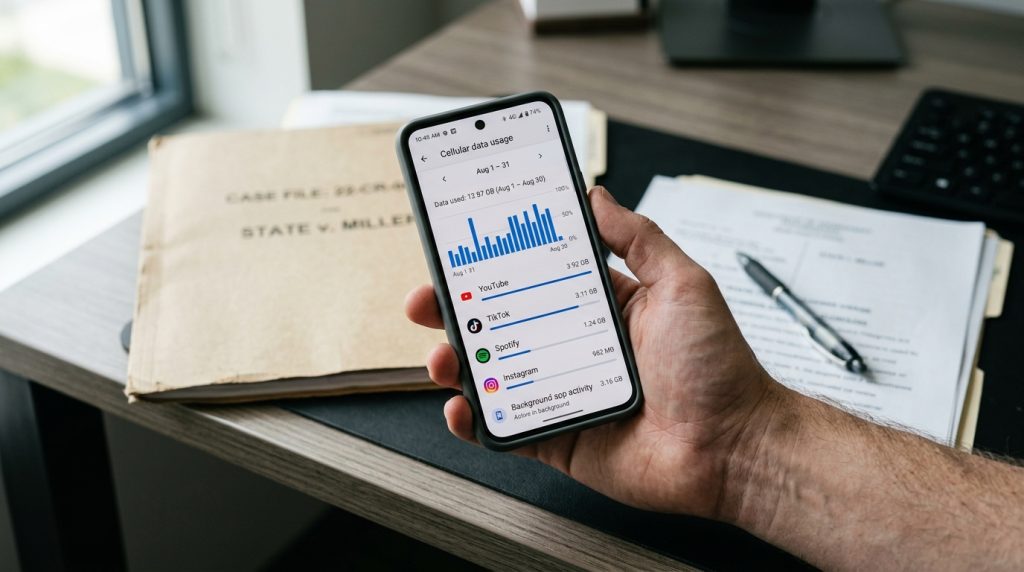
Plaintiffs alleged that Google designed its Android operating system to transfer various types of information from Android devices to Google’s servers without obtaining users’ permission, which consumed customers’ cellular data. According to the lawsuit, some of these transfers occurred in the background without notifying users, even when devices remained completely idle, all applications were closed, and users were not actively interacting with their phones.
Court filings state that Google Play Services, a core Android component that runs continuously in the background, transmitted data to Google’s servers over cellular networks whenever Wi-Fi connections were unavailable. Plaintiffs claimed that these transmissions continued automatically without user action, even while device screens remained locked. According to the filings, Google used the transmitted data to deploy software updates, diagnose technical issues, monitor device performance, develop products, protect the Android ecosystem, support advertising operations, and configure software settings.
At the center of the lawsuit, plaintiffs argued that Google made a deliberate design choice. They alleged that Google could have limited these background transmissions to Wi-Fi connections but instead allowed them to occur over users’ cellular networks, resulting in data usage that consumers ultimately paid for.
The lawsuit’s key evidence: Android had a “stop background data” toggle that plaintiffs said didn’t actually stop the transfers Google was making to its own servers.
Google’s Defense
Google did not accept the allegations at any stage of either case. A Google spokesperson said the transfers are necessary to maintain the performance of billions of Android devices around the world, and that they take up less cellular data than sending a single photo. Google also argued that Android users consent to the transfers through multiple terms of use agreements and device settings options.
At trial, Google countered that the transfers supported essential functions such as security and performance, and that user consent was obtained through its terms of use. That defense did not persuade the California jury.
The Legal Theory That Made These Cases Possible
Both lawsuits rested on a single legal argument that courts had never applied to cellular data before. This appears to be the first time a jury has found that unauthorized consumption of cellular data by a tech company constitutes “conversion” — a legal theory typically reserved for theft or misuse of tangible property.
A successful conversion plaintiff must plead and prove ownership or rightful possession of property, the defendant’s use of that property in violation of the plaintiff’s rights, and resulting damages. The federal district court initially dismissed the case. It ruled that a cellular data plan was a contractual right, not a property right, and therefore couldn’t be “converted.” Plaintiffs appealed.
On February 28, 2024, the Ninth Circuit unanimously reversed the district court’s decision dismissing plaintiffs’ conversion claims. The court held that cellular data is property under California law, which allows plaintiffs to pursue their claims on behalf of Android users against Google to recover the fair market value of the cellular data that Google unlawfully took. Taylor is the first precedential decision to assess whether cellular data is property.
The Ninth Circuit found that plaintiffs satisfactorily established cellular data as a form of personal property subject to conversion, given its definable nature, potential for exclusive control, and plaintiffs’ legitimate expectations based on their data plans. That ruling changed everything. It put real financial exposure on Google and set the stage for both settlements.
Case 1: Csupo v. Google LLC — California Jury Verdict
Court: Superior Court of California, County of Santa Clara
Case No.: 19CV352557
Filed: August 9, 2019
Class Period: August 9, 2016 – present
Class Size: Approximately 14 million California Android users
In the California case, plaintiffs Attila Csupo, Andrew Burke, and Kerry Hecht alleged that Android devices transferred data to Google’s servers in the background without notifying users. According to the lawsuit, these transmissions continued even when phones remained completely idle, with no user interaction and all applications closed.
The trial began on June 2, 2025, in Santa Clara County Superior Court. After hearing nearly a month of testimony and reviewing extensive evidence, the jury returned a 9-3 verdict in favor of the class on July 1, 2025. The jury awarded $314.6 million in damages.
Jurors concluded that Android users had a property interest in their cellular data and found that Google interfered with that property by knowingly using cellular data without users’ consent.
Plaintiffs’ attorneys argued that the evidence supported damages of up to $816 million. However, the jury ultimately awarded a lower amount, which counsel described as conservative. The damages calculation relied on Google Fi’s published rate of $10 per gigabyte as a benchmark for the value of the cellular data allegedly consumed.
After the verdict, the parties entered settlement negotiations. Those discussions resulted in a proposed $350 million settlement, which exceeds the jury’s award by approximately $35 million. As part of the agreement, Google also agreed to revise certain disclosures and consent materials to provide consumers with clearer information about the practices challenged in the lawsuit.
Plaintiffs’ Counsel: Glen Summers, Karma Giulianelli, Hamilton Hill, Lin Brenza (Bartlit Beck LLP); Marc Wallenstein, Chad Bell (Korein Tillery LLC); Elizabeth Pitkin (McManis Faulkner)
Google’s Counsel: Whitty Somvichian and Michael Attanasio (Cooley LLP)
Case 2: Taylor et al. v. Google LLC — Federal Settlement
Court: U.S. District Court, Northern District of California, San Jose Division
Case No.: 5:20-cv-07956-VKD
Judge: Hon. Virginia K. DeMarchi
Filed: November 12, 2020
Class Period: November 12, 2017 – date of final approval
Class Size: Approximately 100 million non-California Android users
Named plaintiffs are Joseph Taylor, Mick Cleary, and Jennifer Nelson, suing on behalf of more than 100 million Americans who used Android phones on carrier data plans.
The parties carried out extensive discovery during the case. Google produced tens of thousands of internal documents, while plaintiffs analyzed billions of Android data logs. Plaintiffs’ experts spent nearly 50 days examining Google’s proprietary source code in person. Attorneys also conducted more than 40 depositions, including testimony from 17 Google employees and a dozen experts specializing in computer science, telecommunications, and economics.
On November 13 and 14, 2024, the parties engaged in two days of in-person mediation with the assistance of renowned mediators Kenneth R. Feinberg and Camille S. Biros. Following the jury verdict in Csupo and briefing of the parties’ respective post-trial motions in that case, the parties resumed their settlement negotiations with the assistance of the same mediators.
Plaintiffs calculate that they could potentially seek damages of approximately $2 billion — or about $19.05 per class member — using the updated damages methodology. Using $2 billion as the measure of Google’s potential exposure, the $135 million settlement fund represents a negotiated resolution that avoided trial risk for both sides.
On March 5, 2026, Magistrate Judge Virginia K. DeMarchi granted the plaintiffs’ motion for preliminary approval of the class action settlement.
Beyond cash, the settlement includes binding injunctive relief. The injunctive relief requires Google to clearly disclose the conduct at issue and the fact that it consumes cellular data. Plaintiffs’ economist calculated that this relief will avoid the prospective conversion of approximately $300 million worth of cellular data per year using the industry average price.
Settlement Administrator: Angeion Group LLC
Settlement Class Counsel: Marc A. Wallenstein (Korein Tillery LLC); Glen E. Summers (Bartlit Beck LLP)
Who Qualifies
Federal settlement ($135 million — Taylor v. Google):
Class members are individuals who have used a mobile device running the Android operating system with a cellular data plan to access the internet through cellular networks at any time from November 12, 2017, to the date the settlement receives final approval, excluding persons who are class members in Csupo v. Google LLC.
California settlement ($350 million — Csupo v. Google):
Class members are those who resided in the State of California, used a mobile phone running a Google-licensed version of Android, and had a cellular data plan at any time from August 9, 2016, to the present.
California residents are automatically excluded from the federal settlement. The two cases do not overlap.
Settlement Amounts and Payments
The federal settlement distributes $135 million across an estimated 100 million class members. The net settlement fund is estimated at around $85 million after attorney fees and administrative costs are deducted. Payments go out pro-rata — the final amount per person depends on how many class members participate. If participation is high, individual payments could range from approximately $1.01 to $1.48.
No claim form is required. Class members who do not exclude themselves will automatically receive settlement benefits. Class members who wish to receive payment via direct deposit or another method must select their preferred payment method on the settlement website.
Payment options include PayPal, Venmo, Zelle, ACH, or Virtual Mastercard. Payments have not been sent yet. If the court grants final approval and no appeals delay the process, eligible Android users who did not exclude themselves may receive a settlement payment later. Realistically, payments are unlikely before late 2026 or early 2027 if appeals are filed.
Key Case Timeline
Csupo v. Google (California)
- August 9, 2019 — Complaint filed, Santa Clara Superior Court
- October 26, 2023 — Class certified
- June 2, 2025 — Trial begins
- July 1, 2025 — Jury verdict: $314,626,932 awarded (9-3)
- 2025 — Parties negotiate; settlement reached at $350 million
Taylor v. Google (Federal)
- November 12, 2020 — Complaint filed, N.D. California
- 2022 — District court dismisses conversion claim
- February 28, 2024 — Ninth Circuit unanimously reverses dismissal (Taylor v. Google, No. 22-16654)
- November 2024 — Mediation begins (Kenneth Feinberg, Camille Biros)
- December 23, 2025 — Settlement agreement signed
- January 27, 2026 — Preliminary approval motion filed
- March 5, 2026 — Preliminary approval granted by Judge DeMarchi
- May 29, 2026 — Opt-out and objection deadline (now passed)
- June 23, 2026 — Final approval hearing
FAQs
Is the cellular data class action real?
Yes. The lawsuit alleges Android devices used consumers’ cellular data for background transmissions without proper consent. Google denies wrongdoing.
Who is eligible for Google’s $700 million settlement payout?
The $700 million settlement generally applies to eligible U.S. consumers who purchased apps or made in-app purchases through Google Play during the covered period.
Does Google have a class action lawsuit against it?
Yes. Google has faced several class action lawsuits involving privacy, data collection, advertising practices, and consumer protection issues.
Is the Google Android lawsuit real?
Yes. The lawsuit claims Android devices transmitted data to Google servers using users’ cellular data without adequate disclosure. Google disputes the allegations.
How much will I receive from the $135 million Google settlement?
The net settlement fund is estimated at around $85 million after attorney fees and administrative costs are deducted. If participation is high, individual payments to each class member could range from approximately $1.01 to $1.48. The exact amount is not confirmed until after final approval.
Are California Android users covered by the federal $135 million settlement?
No. California Android users are excluded from the settlement. A class action filed in July 2025 made similar allegations and ultimately settled for $314.6 million, covering approximately 14 million California Android users.
What is “conversion” and why does it matter here?
Plaintiffs argued that Google secretly consumed significant quantities of Android users’ cellular data for its own purposes without their knowledge or consent, including when the phone was completely idle in a pocket or on a nightstand. They argued this amounts to conversion — meaning theft — of the cellular data by Google. The Ninth Circuit agreed the claim was properly pleaded, making this the first precedential ruling that cellular data qualifies as property under California law.
When will payments be distributed?
Payments are issued after the court grants final approval at the June 23, 2026, Final Approval Hearing and any appeals are resolved. The appeal process can take a year or more.
What should I do right now?
The opt-out deadline of May 29, 2026, has passed. Those who qualify should look out for a personalized notice by mail or email that includes a Notice ID and confirmation code to select a preferred payment method. Visit FederalCellularClassAction.com or call 1-844-655-4255 for updates.
Did Google admit wrongdoing?
No. Google denies the claims in this lawsuit and that it did anything wrong. The court has not decided in favor of either the plaintiffs or Google.
What This Case Means Beyond the Payout
Plaintiffs’ attorneys described the California verdict as “the tip of the iceberg.” They pointed out that a federal trial involving nearly identical claims was scheduled for April 2026. However, Google avoided that trial by agreeing to a $135 million settlement after the California jury verdict significantly increased its litigation risk.
Attorneys have warned tech-sector clients that fine-print disclosures may not shield them from liability when consumer control is lacking or unclear. Regulatory and litigation pressure around digital privacy continues to increase. Similar concerns are driving consumer data privacy lawsuits against other major platforms.
Google is not alone. Tech companies across the financial and consumer sectors are facing similar scrutiny — as seen in recent data breach class action litigation targeting platforms that failed to protect user data.
The two cases together established that a monthly cellular data allowance is personal property — and that background software transfers, even at fractions of a megabyte, can give rise to a viable conversion claim against a major technology company.
Official settlement website: FederalCellularClassAction.com
Settlement administrator: Angeion Group LLC
Contact: Info@FederalCellularClassAction.com | 1-844-655-4255
Mailing address: Federal Cellular Class Action c/o Settlement Administrator, 1650 Arch Street, Suite 2210, Philadelphia, PA 19103

Sadia Parveen is a content writer at ClassAction24.com who creates informational articles on class action lawsuits, consumer protection matters, and legal developments. Her work focuses on researching publicly available information and presenting it in a clear and neutral format for general readers. She does not provide legal advice or professional legal services.