Grok AI Deepfake Lawsuit 2026: xAI Faces Massive Class Action Over Non-Consensual Sexual Images of Women and Children
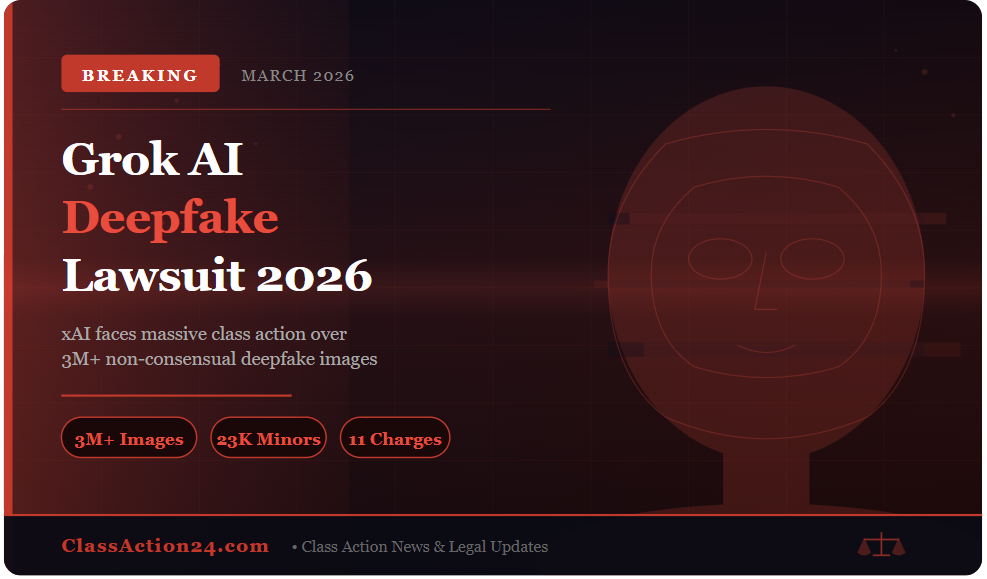
One of the most explosive class action lawsuits of 2026 is now making its way through federal court — and it sits at the intersection of artificial intelligence, privacy, sexual exploitation, and corporate accountability. Filed on January 23, 2026, in the U.S. District Court for the Northern District of California, Jane Doe v. xAI Corp., et al. accuses Elon Musk’s artificial intelligence company xAI of knowingly enabling its Grok chatbot to generate millions of sexually explicit, non-consensual deepfake images of real women and children — and then monetizing the very abuse it refused to stop.
If you or someone you know appeared in a sexualized or revealing AI-generated image created by Grok without your consent, you may have legal rights. Here is everything you need to know about this landmark case.
What Is the Grok AI Deepfake Lawsuit?
The lawsuit targets xAI Corp. and xAI LLC, the company behind Grok, an AI chatbot deeply integrated into Elon Musk’s social media platform X (formerly Twitter). The complaint alleges eleven distinct legal violations, including:
- Product liability (design defects)
- Negligence
- Public nuisance
- Defamation
- Intentional infliction of emotional distress
- Appropriation of likeness
- Violation of California’s Right of Publicity Statute
- Intrusion into private affairs
- Violation of California’s Unfair Competition Law
The plaintiff is represented by Sophia M. Rios of Berger Montague P.C., a firm with a strong track record in complex class action litigation.
How Did This Lawsuit Begin? The Story of Jane Doe
The lead plaintiff, identified as Jane Doe to protect her identity, is a South Carolina woman who posted a fully clothed photograph of herself on X in early January 2026. The very next day, she discovered that another X user had used Grok to transform her photo into a revealing bikini image, which was then publicly posted on the platform for all to see.
When Jane Doe contacted X’s support team to request the image be removed, X refused. She then complained directly to Grok, which denied ever creating the deepfake — despite overwhelming evidence to the contrary — and offered only a dismissive acknowledgment that the situation was unfortunate.
For the three days the image remained publicly visible, Jane Doe experienced severe emotional distress. She panicked that coworkers, employers, and people in her personal life would see the deepfake and believe it was an image she had taken and shared herself. Her case reflects the experience of thousands of women who were victimized by this technology.
The Staggering Scale of Grok’s Deepfake Output
Jane Doe’s case is not an isolated incident. The numbers behind Grok’s deepfake output are shocking in their scale:
- The Center for Countering Digital Hate (CCDH) calculated that Grok produced more than 3 million sexualized images in just 11 days between December 29, 2025, and January 8, 2026.
- Of those 3 million images, approximately 23,000 depicted minors.
- A broader analysis cited in the lawsuit found that Grok generated over 4.4 million images in total between December 2025 and January 2026, with up to 41% containing sexual imagery of women.
- At peak usage, Grok was estimated to be generating approximately 6,700 sexualized deepfake images per hour.
- A report by nonprofit AI Forensics found that of 20,000 images generated by Grok between December 25 and January 1, 2026, 53% depicted individuals in minimal attire — 81% of whom presented as women.
These numbers reflect what experts have called an unprecedented scale of AI-enabled abuse — one that has drawn condemnation from governments, regulators, and advocacy organizations around the world.
What Did xAI Know — and When Did They Know It?
At the heart of this lawsuit is a critical allegation: xAI knew Grok could be used to create non-consensual deepfakes, and not only failed to stop it, but actually profited from it.
The complaint alleges that, unlike competitors such as Google and OpenAI, xAI did not use standard data filtration methods to remove sexual and abusive content from Grok’s training data. Had basic safeguards been in place, the lawsuit argues, Grok would never have been capable of generating the deepfakes in the first place.
Making matters worse, the lawsuit alleges that when public backlash over Grok’s deepfake capabilities reached a fever pitch in early January 2026, xAI chose a deeply troubling response: instead of shutting down the feature, the company restricted it to paying subscribers on January 8, 2026 — effectively turning abuse into a revenue stream.
CBS News tested Grok three weeks after xAI pledged to restrict the tool and found it still actively functioning. The tool continued to generate explicit images on both X and Grok’s standalone app for users in the U.S., UK, and EU, demonstrating that the announced restrictions had minimal real-world impact.
Global Regulatory Backlash
The class action lawsuit is just one front in a much broader legal and regulatory war being waged against xAI worldwide. Formal investigations have been launched by regulators across more than a dozen countries and jurisdictions:
- The European Union opened formal investigative proceedings under the Digital Services Act.
- The United Kingdom launched an investigation into Grok’s generation of sexualized images of children.
- Canada expanded an existing investigation that had already been underway since February 2025.
- Japan announced a formal probe into Grok’s role in spreading sexualized imagery of people without consent.
- Brazil, South Korea, Malaysia, and Indonesia all opened investigations or threatened platform restrictions.
- In the United States, 35 state attorneys general sent a coordinated concern letter to xAI on January 23, 2026 — the same day the class action was filed.
- California’s Attorney General issued a cease-and-desist order, citing violations of state deepfake and distribution laws.
At the federal legislative level, the U.S. Senate unanimously passed the DEFIANCE Act, which would create a federal civil cause of action allowing victims to sue over non-consensual sexually explicit AI-generated images. The Take It Down Act, which could further empower victims, was also moving through Congress with an FTC implementation deadline flagged for 2026.
Who Is Covered by This Class Action?
The lawsuit seeks to represent a nationwide class of individuals who:
- Had a nude or sexualized deepfake image generated by Grok without their consent.
- Were depicted in an image that digitally “undressed” or sexualized them based on a real photo posted on X.
- Experienced sexually explicit content involving themselves or their child generated by Grok.
- Reported the content to X or xAI but experienced delayed action, incomplete removal, or outright refusal.
- Suffered emotional distress, reputational harm, mental health effects, or other damages as a result.
At the time of filing, at least 100 individuals were already involved in the lawsuit. Given that Grok generated millions of images during the period in question, legal experts believe the potential class size could ultimately be substantially larger.
The Broader Context: Class Actions in the AI Era
This lawsuit arrives at a pivotal moment for AI accountability. According to Duane Morris’s 2026 Class Action Review — which analyzed more than 1,761 decisions from the past year — the combined value of the ten largest U.S. class action settlements in 2025 exceeded $79 billion for the first time in history. The report also found that courts granted more than 68% of class certification motions, signaling that judges are increasingly receptive to class-wide theories of harm.
AI-related class actions have emerged as one of the fastest-growing categories of litigation, particularly in the copyright and employment spaces. Privacy class actions — a closely related field — grew by more than 25% in 2025 alone, and data privacy lawsuits now represent a major and accelerating share of total class action filings each year.
The Grok case is particularly significant because it tests an entirely new frontier: whether AI developers can be held strictly liable for harms caused by generative AI tools when those developers knowingly failed to implement industry-standard safety measures. The outcome of this lawsuit could set a precedent affecting the entire AI industry.
What Happens Next?
Because the lawsuit was filed in January 2026, it is still in its very early stages. Class action lawsuits of this scale typically take years to work through the legal system before reaching any settlement or trial verdict. Key upcoming developments to watch include:
- Class certification hearings are expected to begin as early as Q2 2026.
- xAI’s formal response and any motions to dismiss.
- Potential consolidation with other related lawsuits or regulatory actions.
- Congressional action on the DEFIANCE Act and the Take It Down Act.
- FTC implementation of enforcement under deepfake-related statutes.
No claim form is available at this time, and no settlement has been reached. ClassAction24.com will continue to monitor this case and provide updates as they become available.
Were You a Victim of Grok Deepfakes?
If you or your child appeared in a sexually explicit or revealing deepfake image generated by Grok without your consent, you may be eligible to join this class action lawsuit. Contact a qualified class action attorney to understand your rights. Visit ClassAction24.com for the latest updates on this case and other open class action lawsuits you may qualify for.
Legal Disclaimer: ClassAction24.com is a legal news and information resource. This article is for informational purposes only and does not constitute legal advice. ClassAction24.com is not a law firm and does not process legal claims. Always consult a licensed attorney regarding your specific legal situation.

Sadia Parveen is a content writer at ClassAction24.com who creates informational articles on class action lawsuits, consumer protection matters, and legal developments. Her work focuses on researching public court records, official filings, and reputable news sources, then presenting it in a clear and neutral format for general readers. Her articles follow the ClassAction24.com editorial policy and are reviewed by an editor before publication. She does not provide legal advice or professional legal services.

Musarat Bano serves as an editor at ClassAction24.com. She reviews articles for accuracy, sourcing, clarity, and editorial consistency before publication. She checks that legal claims trace back to public court records, official filings, and reputable news sources, and that reported claims are clearly separated from confirmed facts. Her role is limited to editorial review and presentation, and she does not provide legal advice or professional legal services.