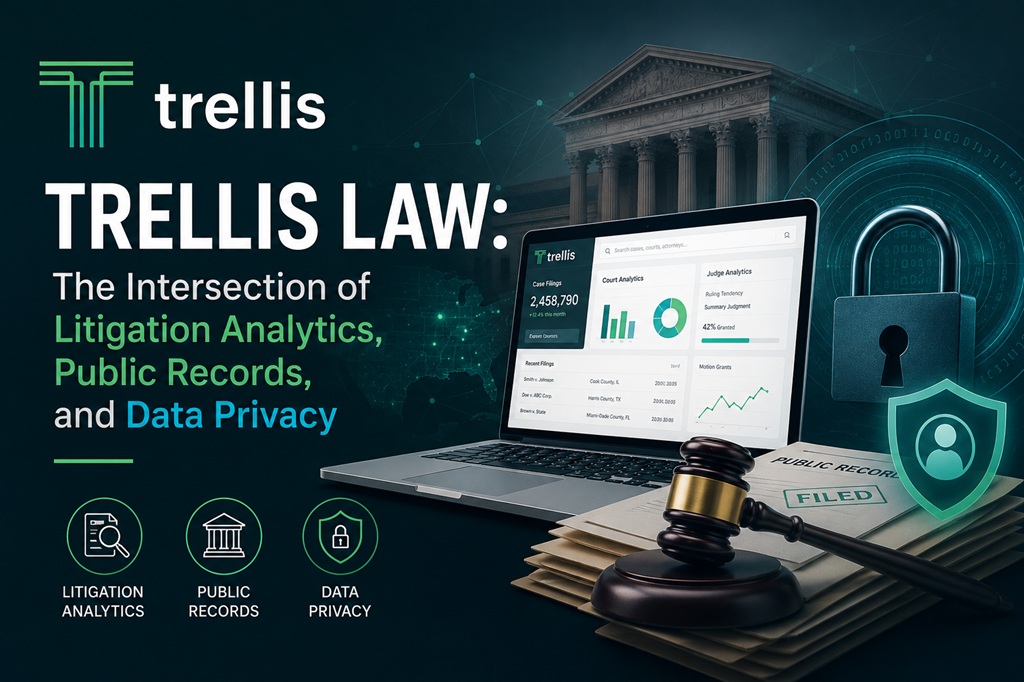
Trellis Law: The Intersection of Litigation Analytics, Public Records, and Data Privacy
Trellis Law functions as a prominent search engine for state court dockets and judicial analytics. The platform compiles millions of public lawsuits, motions, and judge rulings into a single database. Attorneys use this intelligence to research opposing counsel and predict judicial behavior. Private individuals search the database to monitor their personal reputations or seek court records removal options.
Public records indexing creates significant conflict between open-access information and personal data privacy. Aggregators index party names on public search engines and paywall detailed docket information. This practice sparks legal debates regarding the right of publicity and data broker regulations. This comprehensive guide outlines the Trellis Law opt-out process and details the platform’s current legal status.
What is Trellis Law? An Overview of the State Court Aggregator
Defining Trellis: Litigation Analytics vs. Public Records Databases
Trellis Law is a legal technology platform. The system operates as a state court data aggregator and research tool. Users search trial court records, dockets, and judicial decisions on the platform.
Trellis provides litigation analytics alongside raw court data. Attorneys analyze the judge’s decision history and the opposing counsel’s track records through this software. Users must evaluate what the court records actually show to determine the final outcome of dismissed or settled claims. The platform differs from traditional credit bureaus or consumer databases. Trellis focuses exclusively on court proceedings and judicial metrics.
NOTE
Can Trellis Law legally refuse to remove my public court records?Trellis Law can legally refuse to remove unsealed court records. Aggregators hold a First Amendment right to publish truthful public information. Trellis must remove records only when a court seals or expunges the case.
The Scope of Trellis’s Database: Over 45 States and Local Trial Courts
Trellis indexes hundreds of millions of court documents from state courts. The database covers local trial courts in more than 45 states. Most legal databases focus primarily on federal court records. Trellis targets the highly fragmented state court system instead.
The platform collects civil, criminal, family, and probate court dockets. Individual municipal courts feed data into this centralized index. Trellis updates its database periodically by scraping public court portals.
How Trellis AI Uses Grounded Retrieval-Augmented Generation (RAG)
Trellis incorporates artificial intelligence to automate litigation workflows. The software utilizes Retrieval-Augmented Generation to draft motions and summarize filings. This AI tool connects directly to Trellis’s proprietary database of court records.
General AI models often hallucinate legal precedents or fabricate case citations. Trellis limits hallucinations by grounding its AI responses in verified court filings. Attorneys retrieve case outlines and draft documents through one-click solutions. The system protects user data privacy with SOC 2 compliance and encrypted connections.
TIP
How does Trellis AI prevent legal research hallucinations?Trellis AI prevents hallucinations by using Retrieval-Augmented Generation. The system searches its database of verified state court documents first. The AI then summarizes the retrieved results rather than creating text from general training data.
The Legal Status of Trellis Law: Public Records vs. Privacy Rights
The First Amendment Public Records Doctrine: Why Court Records Are Public
State court records belong to the public domain under United States law. The public records doctrine protects the transparency of the judicial system. Citizens possess a constitutional right to access and inspect court proceedings.
The First Amendment shields publishers who disseminate truthful information from public records. Supreme Court precedent in Cox Broadcasting Corp. v. Cohn establishes this protection. Publishers face no liability for printing public facts because the government makes these records accessible. Trellis relies on these constitutional protections to justify its scraping activities.
The Fair Credit Reporting Act (FCRA) Gap: Why Standard Consumer Protections Don’t Apply
The Fair Credit Reporting Act regulates consumer reporting agencies. Federal law obligates these agencies to maintain accurate files and correct errors. Trellis avoids FCRA regulations by marketing its database as a legal research utility.
The company does not act as a consumer reporting agency. Employers and landlords cannot legally use Trellis to run official background checks. Individuals lose standard consumer dispute rights because Trellis operates outside of FCRA jurisdiction. People cannot force a 30-day investigation to correct inaccurate court records on the platform.
Eom v. Trellis Research (2025): The California Right of Publicity Class Action Explained
Plaintiffs filed a class-action lawsuit against Trellis Research in the California federal court in June 2025. The case is Victoria Eom et al v. Trellis Research, Inc., Case No. 2:2025cv05331. Plaintiffs allege that Trellis violates California’s statutory Right of Publicity.
Trellis creates search-engine-optimized landing pages that display individuals’ names next to court cases. These pages reside behind a paywall and require a subscription for full access. Trellis exploits personal identities to drive paid subscriptions, according to the complaint.
The federal judge denied Trellis’s motion to dismiss the lawsuit in December 2025. The court ruled that paywalled preview pages might constitute unauthorized commercial exploitation rather than protected news reporting. This decision threatens Trellis’s core business model of indexing private citizens’ names for profit.
WARNING
Does Trellis Law violate the California Right of Publicity (Civ. Code § 3344)?California courts currently evaluate whether Trellis Law violates the Right of Publicity. Plaintiffs in Eom v. Trellis Research allege that paywalling case previews to sell subscriptions exploits personal identities. A federal judge denied Trellis’s motion to dismiss the lawsuit in December 2025.
How to Remove or Redact Your Records from Trellis Law
The Crucial Difference: Sealed/Expunged Cases vs. Unsealed Public Records
Trellis handles sealed cases differently from unsealed filings. Courts seal records to protect privacy or sensitive information. Aggregators must delete records once a court issues a sealing order. Trellis removes sealed cases quickly after users provide official court documentation.
Unsealed records remain public by default. Trellis does not face a legal obligation to remove unsealed filings. The company occasionally redacts names as a discretionary courtesy to individuals. These courtesy redactions do not delete the entire docket from the database.
Step-by-Step Guide to Requesting a Discretionary Name Redaction
You must identify the specific case URL on Trellis to start the removal process. You can email the removal request to success@trellis.law. Your email should contain the exact link to the record on Trellis.
You must attach the official court order if a judge seals the record. Trellis support reviews each redaction request on a case-by-case basis. The support team notifies you via email when they approve a courtesy redaction. You must follow up with search engines to clear cached results after Trellis modifies the page.
Handling the Cache: How to Use the Google Outdated Content Tool Post-Removal
Google often retains old search snippets even after Trellis redacts your name. Search engine crawlers cache website data for weeks or months. You can accelerate the removal process by using Google Search Console.
You must open the Google Outdated Content Tool in your browser. You paste the exact Trellis URL into the submission field. Google verifies that the webpage content has changed. The search engine updates its index to remove the cached name within days.
IMPORTANT
Why does my name appear on Trellis Law but not the official court website?Trellis Law caches historical scraped records on its proprietary servers. The official court website may delete or restrict files, but Trellis does not sync changes automatically. You must submit a request to Trellis to remove cached listings.
The Corporate Landscape of Trellis Research
The 2025 Founders’ Lawsuit (Clark v. Thaler) and Corporate Control
Co-founders Nicole Clark and Andrew Thaler engaged in a multi-year legal battle over Trellis Research. Clark ousted Thaler from the company and repurchased his shares after their personal relationship soured. Thaler filed counterclaims against Clark and the corporation.
The litigation concluded with a mixed verdict at trial. The California Court of Appeals issued an opinion in May 2025. The appellate panel upheld Clark’s victory regarding corporate control. The court eliminated a punitive damages award against Thaler. Presiding Justice Elwood Lui noted that business partnerships between friends often fail.
Funding and the Future of Generative AI in State Court Litigation
Trellis secured a $15 million investment round to expand its generative AI capabilities. Venture capital firms back the company to challenge legacy legal databases like Westlaw. The funding supports the development of automated motion-drafting software.
Trellis AI queries state court records to construct legal arguments. The corporation plans to expand its data coverage to all 50 states. Attorneys will adopt these tools to expedite litigation tasks. Generative AI will shape the future of state court practice.
FAQs
What is Trellis Law used for?
Trellis Law is a legal research platform that helps attorneys, law firms, insurers, and researchers access state trial court records. Users can search lawsuits, review court filings, analyze judges, track litigation trends, and monitor ongoing cases from a single platform.
Is Trellis Law legitimate?
Yes. Trellis Law is a legitimate legal technology company that provides access to public court records and litigation analytics. Thousands of legal professionals use the platform for state trial court research, case monitoring, and judicial analytics.
Can you get something removed from Trellis Law?
It depends on the record. Trellis generally displays information from public court records, so it usually cannot remove records that remain publicly available through the court. A record may become eligible for removal if the court seals, expunges, or otherwise restricts public access to the case.
Is Trellis Law free?
No. Trellis Law primarily operates as a paid subscription service. Some users may have access to limited free searches, demonstrations, or trial options, but full access to court records, analytics, and advanced features typically requires a paid plan.
Can Trellis Law legally refuse to remove my public court records?
Yes. Under U.S. law, unless a court has officially sealed or expunged the record, public court files are protected under the First Amendment. Trellis is only legally mandated to comply with removal requests for judicially sealed cases; they can legally refuse to remove unsealed public filings.
Why does my case appear on Trellis Law but not on the official court website?
This occurs due to database caching. Trellis scrapes state court dockets and stores them in a proprietary database. If a local court website deletes, purges, or restricts a docket from public view, Trellis’s cached index will still display the case until its scrapers re-index the court or a manual removal request is processed.
Does Trellis Law violate the California Right of Publicity?
This is currently being litigated in federal court (Eom v. Trellis Research, Inc., 2025). The court ruled that while publishing public records is protected, using individuals’ names on search-engine-indexed preview pages to upsell paid subscriptions may constitute unauthorized commercial exploitation under California Civil Code § 3344.
How does Trellis AI prevent legal research hallucinations?
Trellis AI uses Retrieval-Augmented Generation (RAG). Instead of relying on open LLMs that generate answers from general training data, Trellis AI grounds its generative models strictly in its own database of over hundreds of millions of state court dockets, motions, and judicial rulings, matching output to verifiable case citations.

Sadia Parveen is a content writer at ClassAction24.com who creates informational articles on class action lawsuits, consumer protection matters, and legal developments. Her work focuses on researching publicly available information and presenting it in a clear and neutral format for general readers. She does not provide legal advice or professional legal services.